
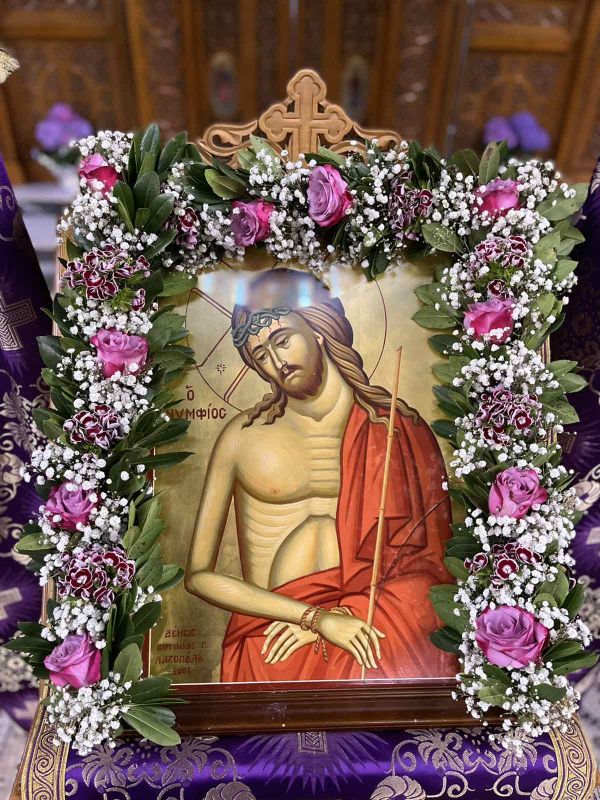
The Bridegroom Service of the Holy and Great Tuesday (Great Monday evening)
ελ
The Bridegroom Service of the Holy and Great Tuesday (Great Monday evening)
Η ακολουθία του Νυμφίου της Αγίας και Μεγάλης Τρίτης (Μεγάλη Δευτέρα εσπέρας)
Priest: Blessed is our God always, now and ever and to the ages of ages.
Ἱερεὺς: Εὐλογητὸς ὁ Θεὸς ἡμῶν, πάντοτε, νῦν, καὶ ἀεί, καὶ εἰς τοὺς αἰῶνας τῶν αἰώνων.
Amen.
Ἀμήν.
Glory to You, our God, glory to You.
Δόξα σοι ὁ Θεὸς ἡμῶν, δόξα σοι.
Heavenly King, Comforter, Spirit of Truth, present in all places and filling all things, treasury of good things and giver of life: come; take Your abode in us; cleanse us of every stain, and save our souls, O Good one.
Βασιλεῦ οὐράνιε, Παράκλητε, τὸ Πνεῦμα τῆς ἀληθείας ὁ πανταχοῦ παρὼν καὶ τὰ πάντα πληρῶν ὁ θησαυρός τῶν ἀγαθῶν καὶ ζωῆς χορηγός, ἐλθὲ καὶ σκήνωσον ἐν ἡμῖν καὶ καθάρισον ἡμᾶς ἀπὸ πάσης κηλῖδος καὶ σῶσον ἀγαθέ, τὰς ψυχὰς ἡμῶν.
Amen.
Ἀμήν.
Trisagion.
Τρισάγιον.
Holy God, Holy Mighty, Holy Immortal, have mercy on us.(3)
Ἅγιος ὁ Θεός, Ἅγιος Ἰσχυρός, Ἅγιος Ἀθάνατος, ἐλέησον ἡμᾶς.(ἐκ γ')
Glory to the Father and the Son and the Holy Spirit.
Δόξα Πατρὶ καὶ Υἱῷ καὶ Ἁγίῳ Πνεύματι.
Both now and ever and to the ages of ages. Amen.
Καὶ νῦν καὶ ἀεὶ καὶ εἰς τοὺς αἰῶνας τῶν αἰώνων. Ἀμήν.
All-holy Trinity, have mercy on us. Lord, forgive our sins. Master, pardon our transgressions. Holy One, visit and heal our infirmities for Your name’s sake.
Παναγία Τριάς, ἐλέησον ἡμᾶς. Κύριε, ἱλάσθητι ταῖς ἁμαρτίαις ἡμῶν. Δέσποτα, συγχώρησον τὰς ἀνομίας ἡμῖν. Ἅγιε, ἐπίσκεψαι καὶ ἴασαι τὰς ἀσθενείας ἡμῶν, ἕνεκεν του ὀνόματός σου.
Lord, have mercy(3)
Κύριε ἐλέησον(ἐκ γ')
Glory to the Father and the Son and the Holy Spirit.
Δόξα Πατρὶ καὶ Υἱῷ καὶ Ἁγίῳ Πνεύματι.
Both now and ever and to the ages of ages. Amen.
Καὶ νῦν καὶ ἀεὶ καὶ εἰς τοὺς αἰῶνας τῶν αἰώνων. Ἀμήν.
Our Father, who art in heaven, hallowed be Thy name. Thy kingdom come, Thy will be done, on earth as it is in heaven. Give us this day our daily bread; and forgive us our trespasses, as we forgive those who trespass against us. And lead us not into temptation, but deliver us from evil.
Πάτερ ἡμῶν, ὁ ἐν τοῖς οὐρανοῖς, ἁγιασθήτω τὸ ὄνομά σου, ἐλθέτω ἡ βασιλεία σου, γενηθήτω τὸ θέλημά σου ὡς ἐν οὐρανῷ καὶ ἐπί τῆς γῆς. Τὸν ἄρτον ἡμῶν τὸν ἐπιούσιον δὸς ἡμῖν σήμερον καὶ ἄφες ἡμῖν τὰ ὀφειλήματα ἡμῶν, ὡς καὶ ἡμεῖς ἀφίεμεν τοῖς ὀφειλέταις ἡμῶν, καὶ μὴ εἰσενέγκῃς ἡμᾶς εἰς πειρασμόν, ἀλλὰ ῥῦσαι ἡμᾶς ἀπὸ τοῦ πονηροῦ.
Priest: For Thine is the kingdom and the power and the glory, of the Father and the Son and the Holy Spirit, now and ever and to ages of ages.
Ἱερεὺς: Ὅτι σοῦ ἐστιν ἡ βασιλεία καὶ ἡ δύναμις καὶ ἡ δόξα τοῦ Πατρὸς καὶ τοῦ Υἱοῦ καὶ τοῦ ἁγίου Πνεύματος, νῦν καὶ ἀεὶ καὶ εἰς τοὺς αἰῶνας τῶν αἰώνων.
Amen.
Ἀμήν.
Lord, have mercy(12)
Κύριε ἐλέησον(ἐκ ιβ')
Glory to the Father and the Son and the Holy Spirit.
Δόξα Πατρὶ καὶ Υἱῷ καὶ Ἁγίῳ Πνεύματι.
Both now and ever and to the ages of ages. Amen.
Καὶ νῦν καὶ ἀεὶ καὶ εἰς τοὺς αἰῶνας τῶν αἰώνων. Ἀμήν.
Come, let us worship and bow down before God our King.
Δεῦτε προσκυνήσωμεν καὶ προσπέσωμεν τῷ βασιλεῖ ἡμῶν Θεῷ.
Come, let us worship and bow down before Christ God our King.
Δεῦτε προσκυνήσωμεν καὶ προσπέσωμεν Χριστῷ τῷ βασιλεῖ ἡμῶν Θεῷ.
Come, let us worship and bow down before Him, Christ our King and God.
Δεῦτε προσκυνήσωμεν καὶ προσπέσωμεν αὐτῷ, Χριστῷ τῷ βασιλεῖ καὶ Θεῷ ἡμῶν.
Psalm 19 (20)
Ψαλμὸς ΙΘʹ (19)
May the Lord hear you in the day of afflictions; may the name of the God of Jacob defend you. May He send you help from His holy place, and may He support you from Zion. May He remember every sacrifice of yours, and may your whole burnt offering be honored. May He give you according to your heart, may He fulfill all your counsel. We will greatly rejoice in Your salvation, and in the name of our God we will be magnified. Now I know the Lord has saved His anointed; He will hear him from His holy heaven; the salvation of His right hand is mighty. Some glory in chariots, some in horses, but in the name of the Lord our God we shall be magnified. Their feet were tied together; so they fell; but we rose up and were restored. O Lord, save Your King, and hear us in the day we call upon You.
Ἐπακούσαι σου Κύριος ἐν ἡμέρᾳ θλίψεως, ὑπερασπίσαι σου τὸ ὄνομα τοῦ Θεοῦ Ἰακώβ. Ἐξαποστείλαι σοι βοήθειαν ἐξ ἁγίου, καὶ ἐκ Σιὼν ἀντιλάβοιτό σου. Μνησθείη πάσης θυσίας σου, καὶ τὸ ὁλοκαύτωμά σου πιανάτω. Δῴη σοι Κύριος κατὰ τὴν καρδίαν σου, καὶ πᾶσαν τὴν βουλήν σου πληρῶσαι. Ἀγαλλιασόμεθα ἐν τῷ σωτηρίῳ σου, καὶ ἐν ὀνόματι Θεοῦ ἡμῶν μεγαλυνθησόμεθα. Πληρῶσαι Κύριος πάντα τὰ αἰτήματά σου. Νῦν ἔγνων ὅτι ἔσωσε Κύριος τὸν χριστὸν αὐτοῦ· ἐπακούσεται αὐτοῦ ἐξ οὐρανοῦ ἁγίου αὐτοῦ· ἐν δυναστείαις ἡ σωτηρία τῆς δεξιᾶς αὐτοῦ. Οὗτοι ἐν ἅρμασιν καὶ οὗτοι ἐν ἵπποις, ἡμεῖς δὲ ἐν ὀνόματι Κυρίου Θεοῦ ἡμῶν μεγαλυνθησόμεθα. Αὐτοὶ συνεποδίσθησαν καὶ ἔπεσαν, ἡμεῖς δὲ ἀνέστημεν καὶ ἀνωρθώθημεν. Κύριε, σῶσον τὸν βασιλέα, καὶ ἐπάκουσον ἡμῶν ἐν ᾗ ἂν ἡμέρᾳ ἐπικαλεσώμεθά σε.
Psalm 20 (21)
Ψαλμὸς Κʹ (20)
O Lord, the king shall be glad in Your power, and in Your salvation he will greatly rejoice. You gave him his soul’s desire, and You did not deprive him of his lips’ request. For You anticipated him with blessings of goodness; You placed a crown of precious stones on his head. He asked You for life, and You gave it to him, length of days unto ages of ages. Great is his glory in Your salvation; glory and majesty You shall place upon him. For You shall give him blessing unto ages of ages; You shall fill him with the joy of Your presence. For the king hopes in the Lord, and in the mercy of the Most High he will not be shaken. May Your hand be found on all Your enemies; may Your right hand find all who hate You. You shall make them like a fiery furnace in the time of Your presence; the Lord shall throw them into confusion in His wrath, and the fire shall devour them. You shall destroy their offspring from the earth and their seed from among the sons of men. For they vented all their evils against You; they reasoned through a counsel they could not establish. For You shall make them turn their back; among Your remnants, You shall make ready their countenance. Be exalted, O Lord, in Your power; we will sing and praise Your mighty deeds.
Κύριε, ἐν τῇ δυνάμει σου εὐφρανθήσεται ὁ βασιλεὺς καὶ ἐπὶ τῷ σωτηρίῳ σου ἀγαλλιάσεται σφόδρα. Τὴν ἐπιθυμίαν τῆς καρδίας αὐτοῦ ἔδωκας αὐτῷ καὶ τὴν θέλησιν τῶν χειλέων αὐτοῦ οὐκ ἐστέρησας αὐτόν. Ὅτι προέφθασας αὐτὸν ἐν εὐλογίαις χρηστότητος, ἔθηκας ἐπὶ τὴν κεφαλὴν αὐτοῦ στέφανον ἐκ λίθου τιμίου. Ζωὴν ᾐτήσατό σε, καὶ ἔδωκας αὐτῷ, μακρότητα ἡμερῶν εἰς αἰῶνα αἰῶνος. Μεγάλη ἡ δόξα αὐτοῦ ἐν τῷ σωτηρίῳ σου, δόξαν καὶ μεγαλοπρέπειαν ἐπιθήσεις ἐπʼ αὐτόν. Ὅτι δώσεις αὐτῷ εὐλογίαν εἰς αἰῶνα αἰῶνος, εὐφρανεῖς αὐτὸν ἐν χαρᾷ μετὰ τοῦ προσώπου σου. Ὅτι ὁ βασιλεὺς ἐλπίζει ἐπὶ Κύριον καὶ ἐν τῷ ἐλέει τοῦ ὑψίστου οὐ μὴ σαλευθῇ. Εὑρεθείη ἡ χείρ σου πᾶσι τοῖς ἐχθροῖς σου, ἡ δεξιά σου εὕροι πάντας τοὺς μισοῦντάς σε. Ὅτι θήσεις αὐτοὺς εἰς κλίβανον πυρὸς εἰς καιρὸν τοῦ προσώπου σου. Κύριος ἐν ὀργῇ αὐτοῦ συνταράξει αὐτούς, καὶ καταφάγεται αὐτοὺς πῦρ. Τὸν καρπὸν αὐτῶν ἀπὸ γῆς ἀπολεῖς καὶ τὸ σπέρμα αὐτῶν ἀπὸ υἱῶν ἀνθρώπων. Ὅτι ἔκλιναν εἰς σὲ κακά, διελογίσαντο βουλάς, αἷς οὐ μὴ δύνωνται στῆναι. Ὅτι θήσεις αὐτοὺς νῶτον· ἐν τοῖς περιλοίποις σου ἑτοιμάσεις τὸ πρόσωπον αὐτῶν. Ὑψώθητι, Κύριε, ἐν τῇ δυνάμει σου· ᾄσομεν καὶ ψαλοῦμεν τὰς δυναστείας σου.
Glory to the Father and the Son and the Holy Spirit.
Δόξα Πατρὶ καὶ Υἱῷ καὶ Ἁγίῳ Πνεύματι.
Both now and ever and to the ages of ages.
Καὶ νῦν καὶ ἀεὶ καὶ εἰς τοὺς αἰῶνας τῶν αἰώνων.
Amen.
Ἀμήν.
Trisagion.
Τρισάγιον.
Holy God, Holy Mighty, Holy Immortal, have mercy on us.(3)
Ἅγιος ὁ Θεός, Ἅγιος Ἰσχυρός, Ἅγιος Ἀθάνατος, ἐλέησον ἡμᾶς.(ἐκ γ')
Glory to the Father and the Son and the Holy Spirit.
Δόξα Πατρὶ καὶ Υἱῷ καὶ Ἁγίῳ Πνεύματι.
Both now and ever and to the ages of ages. Amen.
Καὶ νῦν καὶ ἀεὶ καὶ εἰς τοὺς αἰῶνας τῶν αἰώνων. Ἀμήν.
All-holy Trinity, have mercy on us. Lord, forgive our sins. Master, pardon our transgressions. Holy One, visit and heal our infirmities for Your name’s sake.
Παναγία Τριάς, ἐλέησον ἡμᾶς. Κύριε, ἱλάσθητι ταῖς ἁμαρτίαις ἡμῶν. Δέσποτα, συγχώρησον τὰς ἀνομίας ἡμῖν. Ἅγιε, ἐπίσκεψαι καὶ ἴασαι τὰς ἀσθενείας ἡμῶν, ἕνεκεν του ὀνόματός σου.
Lord, have mercy(3)
Κύριε ἐλέησον(ἐκ γ')
Glory to the Father and the Son and the Holy Spirit.
Δόξα Πατρὶ καὶ Υἱῷ καὶ Ἁγίῳ Πνεύματι.
Both now and ever and to the ages of ages. Amen.
Καὶ νῦν καὶ ἀεὶ καὶ εἰς τοὺς αἰῶνας τῶν αἰώνων. Ἀμήν.
Our Father, who art in heaven, hallowed be Thy name. Thy kingdom come, Thy will be done, on earth as it is in heaven. Give us this day our daily bread; and forgive us our trespasses, as we forgive those who trespass against us. And lead us not into temptation, but deliver us from evil.
Πάτερ ἡμῶν, ὁ ἐν τοῖς οὐρανοῖς, ἁγιασθήτω τὸ ὄνομά σου, ἐλθέτω ἡ βασιλεία σου, γενηθήτω τὸ θέλημά σου ὡς ἐν οὐρανῷ καὶ ἐπί τῆς γῆς. Τὸν ἄρτον ἡμῶν τὸν ἐπιούσιον δὸς ἡμῖν σήμερον καὶ ἄφες ἡμῖν τὰ ὀφειλήματα ἡμῶν, ὡς καὶ ἡμεῖς ἀφίεμεν τοῖς ὀφειλέταις ἡμῶν, καὶ μὴ εἰσενέγκῃς ἡμᾶς εἰς πειρασμόν, ἀλλὰ ῥῦσαι ἡμᾶς ἀπὸ τοῦ πονηροῦ.
Priest: For Thine is the kingdom and the power and the glory, of the Father and the Son and the Holy Spirit, now and ever and to ages of ages.
Ἱερεὺς: Ὅτι σοῦ ἐστιν ἡ βασιλεία καὶ ἡ δύναμις καὶ ἡ δόξα τοῦ Πατρὸς καὶ τοῦ Υἱοῦ καὶ τοῦ ἁγίου Πνεύματος, νῦν καὶ ἀεὶ καὶ εἰς τοὺς αἰῶνας τῶν αἰώνων.
Amen.
Ἀμήν.
Save, O Lord, Your people and bless Your inheritance, granting victory to the faithful over the enemy, and by Your Cross protecting Your commonwealth.
Σῶσον, Κύριε, τὸν λαόν σου καὶ εὐλόγησον τὴν κληρονομίαν σου, νίκας τοῖς βασιλεῦσι κατὰ βαρβάρων δωρούμενος, καὶ τὸ σὸν φυλάττων διὰ τοῦ Σταυροῦ σου πολίτευμα.
Glory to the Father and the Son and the Holy Spirit.
Δόξα Πατρὶ καὶ Υἱῷ καὶ ἁγίῳ Πνεύματι.
You who were lifted on the cross voluntarily, O Christ our God, bestow Your tender compassions upon Your new community to which You gave Your name. Cause our faithful emperors to be glad in Your power, granting them the victories against their adversaries. And for an ally, Lord, may they have You, peace as their armor, the trophy invincible.
Ὁ ὑψωθεὶς ἐν τῷ Σταυρῷ ἑκουσίως, τῇ ἐπωνύμῳ σου καινῇ πολιτείᾳ τοὺς οἰκτιρμούς σου δώρησαι, Χριστὲ ὁ Θεός· εὔφρανον ἐν τῇ δυνάμει σου τοὺς πιστοὺς βασιλεῖς ἡμῶν, νίκας χορηγῶν αὐτοῖς κατὰ τῶν πολεμίων· τὴν συμμαχίαν ἔχοιεν τὴν σήν, ὅπλον εἰρήνης, ἀήττητον τρόπαιον.
Both now and ever and to the ages of ages. Amen.
Καὶ νῦν καὶ ἀεί, καὶ εἰς τοὺς αἰῶνας τῶν αἰώνων. Ἀμήν.
O awesome and unshamable Protection, O good and praiseworthy Theotokos, do not despise our petitions; make firm the community of the Orthodox; save those whom you have called to rule; grant them victory from heaven, for you gave birth to God and are truly blessed.
Προστασία φοβερὰ καὶ ἀκαταίσχυντε, μὴ παρίδῃς, Ἀγαθή, τὰς ἰκεσίας ἡμῶν, πανύμνητε Θεοτόκε· στήριξον Ὀρθοδόξων πολιτείαν, σῷζε οὓς ἐκέλευσας βασιλεύειν, καὶ χορήγει αὐτοῖς οὐρανόθεν τὴν νίκην· διότι ἔτεκες τὸν Θεόν, μόνη εὐλογημένη.
Priest: Have mercy on us, O God, according to Your great mercy, we pray You, hear us and have mercy.
Ἱερεὺς: Ἐλέησον ἡμᾶς, ὁ Θεός, κατὰ τὸ μέγα ἔλεός σου, δεόμεθά σου, ἐπάκουσον καὶ ἐλέησον.
Lord, have mercy(3)
Κύριε ἐλέησον(ἐκ γ')
Priest:Again we pray for pious and Orthodox Christians.
Ἱερεὺς: Ἔτι δεόμεθα ὑπὲρ τῶν εὐσεβῶν καὶ ὀρθοδόξων χριστιανῶν.
Lord, have mercy(3)
Κύριε ἐλέησον(ἐκ γ')
Priest: Again we pray for our Archbishop (name).
Ἱερεὺς: Ἔτι δεόμεθα ὑπὲρ τοῦ Ἀρχιεπισκόπου ἡμῶν (δεῖνος).
Lord, have mercy(3)
Κύριε ἐλέησον(ἐκ γ')
Priest: For You are merciful and benevolent God, and to You we offer up glory, to the Father and the Son and the Holy Spirit, now and ever and to the ages of ages.
Ἱερεὺς: Ὅτι ἐλεήμων καὶ φιλάνθρωπος Θεὸς ὑπάρχεις, καὶ σοὶ τὴν δόξαν ἀναπέμπομεν, τῷ Πατρὶ καὶ τῷ Υἱῷ καὶ τῷ ἁγίῳ Πνεύματι, νῦν καὶ ἀεὶ καὶ εἰς τοὺς αἰῶνας τῶν αἰώνων.
Amen. In the name of the Lord, Father, bless!
Ἀμήν. Ἐν ὀνόματι Κυρίου εὐλόγησον, πάτερ.
Priest: Glory to the holy and consubstantial and life-creating and undivided Trinity always, now and ever and to the ages of ages.
Ἱερεὺς: Δόξα τῇ ἁγίᾳ καὶ ὁμοουσίῳ καὶ ζωοποιῷ καὶ ἀδιαιρέτῳ Τριάδι πάντοτε, νῦν καὶ ἀεὶ καὶ εἰς τοὺς αἰῶνας τῶν αἰώνων.
Amen.
Ἀμήν.
The Six Psalms
Ὁ Ἐξάψαλμος.
Glory to God in the highest, and on earth peace, good will among men.(3)
Δόξα ἐν ὑψίστοις Θεῷ καὶ ἐπὶ γῆς εἰρήνη, ἐν ἀνθρώποις εὐδοκία.(ἐκ γ')
O Lord, You shall open my lips, and my mouth will declare Your praise.(2)
Κύριε, τὰ χείλη μου ἀνοίξεις, καὶ τὸ στόμα μου ἀναγγελεῖ τὴν αἴνεσίν σου.(δίς)
Psalm 3
Ψαλμὸς Γʹ (3)
O Lord, why do those who afflict me multiply? Many are those who rise up against me. Many are those who say to my soul, “There is no salvation for him in his God.” But You, O Lord, are my protector, my glory and the One who lifts up my head. I cried to the Lord with my voice, and He heard me from His holy hill. I lay down and slept; I awoke, for the Lord will help me. I will not be afraid of ten thousands of people who set themselves against me all around. Arise, O Lord, and save me, O my God, for You struck all those who were foolishly at enmity with me; You broke the teeth of sinners. Salvation is of the Lord, and Your blessing is upon Your people.
Κύριε, τί ἐπληθύνθησαν οἱ θλίβοντές με; Πολλοὶ ἐπανίστανται ἐπʼ ἐμέ. Πολλοὶ λέγουσι τῇ ψυχῇ μου· Οὐκ ἔστι σωτηρία αὐτῷ ἐν τῷ Θεῷ αὐτοῦ. Σὺ δέ, Κύριε, ἀντιλήπτωρ μου εἶ, δόξα μου καὶ ὑψῶν τὴν κεφαλήν μου. Φωνῇ μου πρὸς Κύριον ἐκέκραξα, καὶ ἐπήκουσέ μου ἐξ ὄρους ἁγίου αὐτοῦ. Ἐγὼ δὲ ἐκοιμήθην καὶ ὕπνωσα· ἐξηγέρθην, ὅτι Κύριος ἀντιλήψεταί μου. Οὐ φοβηθήσομαι ἀπὸ μυριάδων λαοῦ τῶν κύκλῳ συνεπιτιθεμένων μοι. Ἀνάστα, Κύριε, σῶσόν με ὁ Θεός μου, ὅτι σὺ ἐπάταξας πάντας τοὺς ἐχθραίνοντάς μοι ματαίως, ὀδόντας ἁμαρτωλῶν συνέτριψας. Τοῦ Κυρίου ἡ σωτηρία, καὶ ἐπὶ τὸν λαόν σου ἡ εὐλογία σου.
I lay down and slept; I awoke, for the Lord will help me.
Ἐγὼ ἐκοιμήθην καὶ ὕπνωσα· ἐξηγέρθην, ὅτι Κύριος ἀντιλήψεταί μου.
Psalm 37 (38)
Ψαλμὸς ΛΖʹ (37)
O Lord, do not rebuke me in Your wrath, nor chasten me in Your anger. For Your arrows are fixed in me, and Your hand rests on me; there is no healing in my flesh because of Your wrath; there is no peace in my bones because of my sins. For my transgressions rise up over my head; like a heavy burden they are heavy on me. My wounds grow foul and fester because of my folly. I suffer misery, and I am utterly bowed down; I go all the day long with a sad face. For my loins are filled with mockeries, and there is no healing in my flesh. I am afflicted and greatly humbled; I roar because of the groaning of my heart. O Lord, all my desire is before You, and my groaning is not hidden from You. My heart is troubled; my strength fails me, and the light of my eyes, even this is not with me. My friends and neighbors draw near and stand against me, and my near of kin stand far off; and those who seek my soul use violence, and those who seek evil for me speak folly; and they meditate on deceit all the day long. But I like a deaf man do not hear, and I am like a mute who does not open his mouth. I am like a man who does not hear, and who has no reproofs in his mouth. For in You, O Lord, I hope; You will hear, O Lord my God. For I said, “Let not my enemies rejoice over me, for when my foot was shaken, they boasted against me.” For I am ready for wounds, and my pain is continually with me. For I will declare my transgression, and I will be anxious about my sin. But my enemies live, and are become stronger than I; and those who hate me unjustly are multiplied; those who repaid me evil for good slandered me, because I pursue righteousness; and they threw away my love as though it were a stinking corpse. Do not forsake me, O Lord; O my God, do not depart from me; give heed to help me, O Lord of my salvation.
Κύριε, μὴ τῷ θυμῷ σου ἐλέγξῃς με, μηδὲ τῇ ὀργῇ σου παιδεύσῃς με. Ὅτι τὰ βέλη σου ἐνεπάγησάν μοι, καὶ ἐπεστήριξας ἐπʼ ἐμὲ τὴν χεῖρά σου. Οὐκ ἔστιν ἴασις ἐν τῇ σαρκί μου ἀπὸ προσώπου τῆς ὀργῆς σου, οὐκ ἔστιν εἰρήνη ἐν τοῖς ὀστέοις μου ἀπὸ προσώπου τῶν ἁμαρτιῶν μου. Ὅτι αἱ ἀνομίαι μου ὑπερῇραν τὴν κεφαλήν μου, ὡσεὶ φορτίον βαρὺ ἐβαρύνθησαν ἐπʼ ἐμέ. Προσώζεσαν καὶ ἐσάπησαν οἱ μώλωπές μου ἀπὸ προσώπου τῆς ἀφροσύνης μου. Ἐταλαιπώρησα καὶ κατεκάμφθην ἕως τέλους, ὅλην τὴν ἡμέραν σκυθρωπάζων ἐπορευόμην. Ὅτι αἱ ψόαι μου ἐπλήσθησαν ἐμπαιγμάτων, καὶ οὐκ ἔστιν ἴασις ἐν τῇ σαρκί μου. Ἐκακώθην καὶ ἐταπεινώθην ἕως σφόδρα, ὠρυόμην ἀπὸ στεναγμοῦ τῆς καρδίας μου. Κύριε, ἐναντίον σου πᾶσα ἡ ἐπιθυμία μου, καὶ ὁ στεναγμός μου ἀπὸ σοῦ οὐκ ἀπεκρύβη. Ἡ καρδία μου ἐταράχθη, ἐγκατέλιπέ με ἡ ἰσχύς μου, καὶ τὸ φῶς τῶν ὀφθαλμῶν μου καὶ αὐτὸ οὐκ ἔστι μετʼ ἐμοῦ. Οἱ φίλοι μου καὶ οἱ πλησίον μου ἐξεναντίας μου ἤγγισαν καὶ ἔστησαν, καὶ οἱ ἐγγιστά μου ἀπὸ μακρόθεν ἔστησαν. Καὶ ἐξεβιάζοντο οἱ ζητοῦντες τὴν ψυχήν μου, καὶ οἱ ζητοῦντες τὰ κακά μοι ἐλάλησαν ματαιότητας, καὶ δολιότητας ὅλην τὴν ἡμέραν ἐμελέτησαν. Ἐγὼ δὲ ὡσεὶ κωφὸς οὐκ ἤκουον καὶ ὡσεὶ ἄλαλος οὐκ ἀνοίγων τὸ στόμα αὐτοῦ. Καὶ ἐγενόμην ὡσεὶ ἄνθρωπος οὐκ ἀκούων καὶ οὐκ ἔχων ἐν τῷ στόματι αὐτοῦ ἐλεγμούς. Ὅτι ἐπὶ σοί, Κύριε, ἤλπισα· σὺ εἰσακούση, Κύριε ὁ Θεός μου. Ὅτι εἶπον· Μήποτε ἐπιχαρῶσί μοι οἱ ἐχθροί μου· καὶ ἐν τῷ σαλευθῆναι πόδας μου ἐπʼ ἐμὲ ἐμεγαλοῤῥημόνησαν. Ὅτι ἐγὼ εἰς μάστιγας ἕτοιμος, καὶ ἡ ἀλγηδών μου ἐνώπιόν μού ἐστι διὰ παντός. Ὅτι τὴν ἀνομίαν μου ἐγὼ ἀναγγελῶ καὶ μεριμνήσω ὑπὲρ τῆς ἁμαρτίας μου. Οἱ δὲ ἐχθροί μου ζῶσι καὶ κεκραταίωνται ὑπὲρ ἐμέ, καὶ ἐπληθύνθησαν οἱ μισοῦντές με ἀδίκως. Οἱ ἀνταποδίδοντές μοι κακὰ ἀντὶ ἀγαθῶν ἐνδιέβαλλόν με, ἐπεὶ κατεδίωκον ἀγαθωσύνην. Μὴ ἐγκαταλίπῃς με, Κύριε ὁ Θεός μου, μὴ ἀποστῇς ἀπʼ ἐμοῦ. Πρόσχες εἰς τὴν βοήθειάν μου, Κύριε τῆς σωτηρίας μου.
Do not forsake me, O Lord; O my God, do not depart from me. Give heed to help me, O Lord of my salvation.
Μὴ ἐγκαταλίπῃς με, Κύριε· ὁ Θεός μου, μὴ ἀποστῇς ἀπʼ ἐμοῦ· πρόσχες εἰς τὴν βοήθειάν μου, Κύριε τῆς σωτηρίας μου.
Psalm 62 (63)
Ψαλμὸς ΞΒʹ (62)
O God, my God, I rise early to be with You; my soul thirsts for You. How often my flesh thirsts for You in a desolate, impassable, and waterless land. So in the holy place I appear before You, to see Your power and Your glory. Because Your mercy is better than life, my lips shall praise You. Thus I will bless You in my life; I will lift up my hands in Your name. May my soul be filled, as if with marrow and fatness, and my mouth shall sing praise to You with lips filled with rejoicing. If I remembered You on my bed, I meditated on You at daybreak; for You are my helper, and in the shelter of Your wings I will greatly rejoice. My soul follows close behind You; Your right hand takes hold of me. But they seek for my soul in vain; they shall go into the lowest parts of the earth. They shall be given over to the edge of the sword; they shall be a portion for foxes. But the king shall be glad in God; all who swear by Him shall be praised, for the mouth that speaks unrighteous things is stopped.
Ὁ Θεὸς ὁ Θεός μου, πρὸς σὲ ὀρθρίζω. Ἐδίψησέ σε ἡ ψυχή μου, ποσαπλῶς σοι ἡ σάρξ μου, ἐν γῇ ἐρήμῳ καὶ ἀβάτῳ καὶ ἀνύδρῳ. Οὕτως ἐν τῷ ἁγίῳ ὤφθην σοι τοῦ ἰδεῖν τὴν δύναμίν σου καὶ τὴν δόξαν σου. Ὅτι κρεῖσσον τὸ ἔλεός σου ὑπὲρ ζωάς· τὰ χείλη μου ἐπαινέσουσί σε. Οὕτως εὐλογήσω σε ἐν τῇ ζωῇ μου, καὶ ἐν τῷ ὀνόματί σου ἀρῶ τὰς χεῖράς μου. Ὡς ἐκ στέατος καὶ πιότητος ἐμπλησθείη ἡ ψυχή μου, καὶ χείλη ἀγαλλιάσεως αἰνέσει τὸ στόμα μου. Εἰ ἐμνημόνευόν σου ἐπὶ τῆς στρωμνῆς μου, ἐν τοῖς ὄρθροις ἐμελέτων εἰς σέ· ὅτι ἐγενήθης βοηθός μου, καὶ ἐν τῇ σκέπῃ τῶν πτερύγων σου ἀγαλλιάσομαι. Ἐκολλήθη ἡ ψυχή μου ὀπίσω σου, ἐμοῦ δὲ ἀντελάβετο ἡ δεξιά σου. Αὐτοὶ δὲ εἰς μάτην ἐζήτησαν τὴν ψυχήν μου, εἰσελεύσονται εἰς τὰ κατώτατα τῆς γῆς· παραδοθήσονται εἰς χεῖρας ρομφαίας, μερίδες ἀλωπέκων ἔσονται. Ὁ δὲ βασιλεὺς εὐφρανθήσεται ἐπὶ τῷ Θεῷ, ἐπαινεθήσεται πᾶς ὁ ὀμνύων ἐν αὐτῷ, ὅτι ἐνεφράγη στόμα λαλούντων ἄδικα.
I meditated on You at daybreak. For You are my helper, and in the shelter of Your wings I will greatly rejoice. My soul follows close behind You; Your right hand takes hold of me.
Ἐν τοῖς ὄρθροις ἐμελέτων εἰς σέ· ὅτι ἐγενήθης βοηθός μου, καὶ ἐν τῇ σκέπῃ τῶν πτερύγων σου ἀγαλλιάσομαι. Ἐκολλήθη ἡ ψυχή μου ὀπίσω σου, ἐμοῦ δὲ ἀντελάβετο ἡ δεξιά σου.
Glory to the Father and the Son and the Holy Spirit.
Δόξα Πατρὶ καὶ Υἱῷ καὶ Ἁγίῳ Πνεύματι.
Both now and ever and to the ages of ages. Amen.
Καὶ νῦν καὶ ἀεὶ καὶ εἰς τοὺς αἰῶνας τῶν αἰώνων. Ἀμήν.
Alleluia. Alleluia. Alleluia. Glory to You, O God.(3)
Ἀλληλούϊα. Ἀλληλούϊα. Ἀλληλούϊα. Δόξα σοι, ὁ Θεός.(ἐκ γ')
Lord, have mercy(3)
Κύριε ἐλέησον(ἐκ γ')
Glory to the Father and the Son and the Holy Spirit.
Δόξα Πατρὶ καὶ Υἱῷ καὶ Ἁγίῳ Πνεύματι.
Both now and ever and to the ages of ages. Amen.
Καὶ νῦν καὶ ἀεὶ καὶ εἰς τοὺς αἰῶνας τῶν αἰώνων. Ἀμήν.
Psalm 87 (88)
Ψαλμὸς ΠΖʹ (87)
O Lord God of my salvation, I cry day and night before You. Let my prayer come before You; incline Your ear to my supplication, O Lord. For my soul is filled with sorrows, and my soul draws near to Hades; I am counted among those who go down into the pit; I am like a helpless man, free among the dead, like slain men thrown down and sleeping in a grave, whom You remember no more, but they are removed from Your hand. They laid me in the lowest pit, in dark places and in the shadow of death. Your wrath rested upon me, and You brought all Your billows over me. You removed my acquaintances far from me; they made me an abomination among themselves; I was betrayed, and did not go forth. My eyes weakened from poverty; O Lord, I cry to You the whole day long; I spread out my hands to You. Will You work wonders for the dead? Or will physicians raise them up, and acknowledge You? Shall anyone in the grave describe Your mercy and Your truth in destruction? Shall Your wonders be known in darkness, and Your righteousness in a forgotten land? But I cry to You, O Lord, and in the morning my prayer shall come near to You. Why, O Lord, do You reject my soul, and turn away Your face from me? I am poor and in troubles from my youth; but having been exalted, I was humbled and brought into despair. Your fierce anger passed over me, and Your terrors greatly troubled me; they compassed me like water all the day long; they surrounded me at once. You removed far from me neighbor and friend, and my acquaintances because of my misery.
Κύριε ὁ Θεὸς τῆς σωτηρίας μου, ἡμέρας ἐκέκραξα καὶ ἐν νυκτὶ ἐναντίον σου. Εἰσελθέτω ἐνώπιόν σου ἡ προσευχή μου, κλῖνον τὸ οὖς σου εἰς τὴν δέησίν μου. Ὅτι ἐπλήσθη κακῶν ἡ ψυχή μου, καὶ ἡ ζωή μου τῷ ᾅδῃ ἤγγισε. Προσελογίσθην μετὰ τῶν καταβαινόντων εἰς λάκκον, ἐγενήθην ὡσεὶ ἄνθρωπος ἀβοήθητος, ἐν νεκροῖς ἐλεύθερος, ὡσεὶ τραυματίαι καθεύδοντες ἐν τάφῳ, ὧν οὐκ ἐμνήσθης ἔτι, καὶ αὐτοὶ ἐκ τῆς χειρός σου ἀπώσθησαν. Ἔθεντό με ἐν λάκκῳ κατωτάτῳ, ἐν σκοτεινοῖς καὶ ἐν σκιᾷ θανάτου. Ἐπʼ ἐμὲ ἐπεστηρίχθη ὁ θυμός σου, καὶ πάντας τοὺς μετεωρισμούς σου ἐπήγαγες ἐπʼ ἐμέ. Ἐμάκρυνας τοὺς γνωστούς μου ἀπʼ ἐμοῦ, ἔθεντό με βδέλυγμα ἑαυτοῖς, παρεδόθην καὶ οὐκ ἐξεπορευόμην. Οἱ ὀφθαλμοί μου ἠσθένησαν ἀπὸ πτωχείας· ἐκέκραξα πρὸς σέ, Κύριε, ὅλην τὴν ἡμέραν, διεπέτασα πρὸς σὲ τὰς χεῖράς μου. Μὴ τοῖς νεκροῖς ποιήσεις θαυμάσια; ἢ ἰατροὶ ἀναστήσουσι καὶ ἐξομολογήσονταί σοι; Μὴ διηγήσεταί τις ἐν τῷ τάφῳ τὸ ἔλεός σου καὶ τὴν ἀλήθειάν σου ἐν τῇ ἀπωλείᾳ; Μὴ γνωσθήσεται ἐν τῷ σκότει τὰ θαυμάσιά σου καὶ ἡ δικαιοσύνη σου ἐν γῇ ἐπιλελησμένῃ; Κἀγὼ πρὸς σέ, Κύριε, ἐκέκραξα, καὶ τὸ πρωῒ ἡ προσευχή μου προφθάσει σε. Ἵνα τί, Κύριε, ἀπωθεῖς τὴν ψυχήν μου, ἀποστρέφεις τὸ πρόσωπόν σου ἀπʼ ἐμοῦ; Πτωχός εἰμι ἐγὼ καὶ ἐν κόποις ἐκ νεότητός μου, ὑψωθεὶς δὲ ἐταπεινώθην καὶ ἐξηπορήθην. Ἐπʼ ἐμὲ διῆλθον αἱ ὀργαί σου, οἱ φοβερισμοί σου ἐξετάραξάν με, ἐκύκλωσάν με ὡσεὶ ὕδωρ ὅλην τὴν ἡμέραν, περιέσχον με ἅμα. Ἐμάκρυνας ἀπʼ ἐμοῦ φίλον καὶ πλησίον, καὶ τοὺς γνωστούς μου ἀπὸ ταλαιπωρίας.
O Lord God of my salvation, I cry day and night before You. Let my prayer come before You; incline Your ear to my supplication, O Lord.
Κύριε ὁ Θεὸς τῆς σωτηρίας μου, ἡμέρας ἐκέκραξα καὶ ἐν νυκτὶ ἐναντίον σου. Εἰσελθέτω ἐνώπιόν σου ἡ προσευχή μου, κλῖνον τὸ οὖς σου εἰς τὴν δέησίν μου.
Psalm 102 (103)
Ψαλμὸς ΡΒʹ (102)
Bless the Lord, O my soul, and everything within me, bless His holy name. Bless the Lord, O my soul, and forget not all His rewards: who is merciful to all your transgressions, who heals all your diseases, who redeems your life from corruption, who crowns you with mercy and compassion, who satisfies your desire with good things; and your youth is renewed like the eagle’s. The Lord shows mercies and judgment to all who are wronged. He made known His ways to Moses, the things He willed to the sons of Israel. The Lord is compassionate and merciful, slow to anger, and abounding in mercy. He will not become angry to the end, nor will He be wrathful forever; He did not deal with us according to our sins, nor reward us according to our transgressions; for according to the height of heaven from earth, so the Lord reigns in mercy over those who fear Him; as far as the east is from the west, so He removes our transgressions from us. As a father has compassion on his children, so the Lord has compassion on those who fear Him, for He knows how He formed us; He remembers we are dust. As for man, his days are like grass, as a flower of the field, so he flourishes; for the wind passes through it, and it shall not remain; and it shall no longer know its place. But the mercy of the Lord is from age to age upon those who fear Him, and His righteousness upon children’s children, to such as keep His covenant and remember His commandments, to do them. The Lord prepared His throne in heaven, and His Kingdom rules over all. Bless the Lord, all you His angels, mighty in strength, who do His word, so as to hear the voice of His words. Bless the Lord, all you His hosts, His ministers who do His will; bless the Lord, all His works, in all places of His dominion; bless the Lord, O my soul.
Εὐλόγει, ἡ ψυχή μου, τὸν Κύριον, καί, πάντα τὰ ἐντός μου, τὸ ὄνομα τὸ ἅγιον αὐτοῦ. Εὐλόγει, ἡ ψυχή μου, τὸν Κύριον, καὶ μὴ ἐπιλανθάνου πάσας τὰς ἀνταποδόσεις αὐτοῦ. Τὸν εὐιλατεύοντα πάσας τὰς ἀνομίας σου, τὸν ἰώμενον πάσας τὰς νόσους σου. Τὸν λυτρούμενον ἐκ φθορᾶς τὴν ζωήν σου, τὸν στεφανοῦντά σε ἐν ἐλέει καὶ οἰκτιρμοῖς. Τὸν ἐμπιπλῶντα ἐν ἀγαθοῖς τὴν ἐπιθυμίαν σου, ἀνακαινισθήσεται ὡς ἀετοῦ ἡ νεότης σου. Ποιῶν ἐλεημοσύνας ὁ Κύριος καὶ κρῖμα πᾶσι τοῖς ἀδικουμένοις. Ἐγνώρισε τὰς ὁδοὺς αὐτοῦ τῷ Μωϋσῇ, τοῖς υἱοῖς Ἰσραὴλ τὰ θελήματα αὐτοῦ. Οἰκτίρμων καὶ ἐλεήμων ὁ Κύριος, μακρόθυμος καὶ πολυέλεος· οὐκ εἰς τέλος ὀργισθήσεται, οὐδὲ εἰς τὸν αἰῶνα μηνιεῖ. Οὐ κατὰ τὰς ἀνομίας ἡμῶν ἐποίησεν ἡμῖν, οὐδὲ κατὰ τὰς ἁμαρτίας ἡμῶν ἀνταπέδωκεν ἡμῖν, ὅτι κατὰ τὸ ὕψος τοῦ οὐρανοῦ ἀπὸ τῆς γῆς ἐκραταίωσε Κύριος τὸ ἔλεος αὐτοῦ ἐπὶ τοὺς φοβουμένους αὐτόν. Καθʼ ὅσον ἀπέχουσιν ἀνατολαὶ ἀπὸ δυσμῶν, ἐμάκρυνεν ἀφʼ ἡμῶν τὰς ἀνομίας ἡμῶν. Καθὼς οἰκτίρει πατὴρ υἱούς, ᾠκτίρησε Κύριος τοὺς φοβουμένους αὐτόν, ὅτι αὐτὸς ἔγνω τὸ πλάσμα ἡμῶν, ἐμνήσθη ὅτι χοῦς ἐσμεν. Ἄνθρωπος, ὡσεὶ χόρτος αἱ ἡμέραι αὐτοῦ· ὡσεὶ ἄνθος τοῦ ἀγροῦ, οὕτως ἐξανθήσει. Ὅτι πνεῦμα διῆλθεν ἐν αὐτῷ, καὶ οὐχ ὑπάρξει, καὶ οὐκ ἐπιγνώσεται ἔτι τὸν τόπον αὐτοῦ. Τὸ δὲ ἔλεος τοῦ Κυρίου ἀπὸ τοῦ αἰῶνος καὶ ἕως τοῦ αἰῶνος ἐπὶ τοὺς φοβουμένους αὐτόν, καὶ ἡ δικαιοσύνη αὐτοῦ ἐπὶ υἱοῖς υἱῶν, τοῖς φυλάσσουσι τὴν διαθήκην αὐτοῦ καὶ μεμνημένοις τῶν ἐντολῶν αὐτοῦ τοῦ ποιῆσαι αὐτάς. Κύριος ἐν τῷ οὐρανῷ ἡτοίμασε τὸν θρόνον αὐτοῦ, καὶ ἡ βασιλεία αὐτοῦ πάντων δεσπόζει. Εὐλογεῖτε τὸν Κύριον, πάντες οἱ Ἄγγελοι αὐτοῦ, δυνατοὶ ἰσχύϊ, ποιοῦντες τὸν λόγον αὐτοῦ, τοῦ ἀκοῦσαι τῆς φωνῆς τῶν λόγων αὐτοῦ. Εὐλογεῖτε τὸν Κύριον, πᾶσαι αἱ Δυνάμεις αὐτοῦ, λειτουργοὶ αὐτοῦ, ποιοῦντες τὸ θέλημα αὐτοῦ. Εὐλογεῖτε τὸν Κύριον, πάντα τὰ ἔργα αὐτοῦ, ἐν παντὶ τόπῳ τῆς δεσποτείας αὐτοῦ· εὐλόγει, ἡ ψυχή μου, τὸν Κύριον.
In all places of His dominion; Bless the Lord, O my soul.
Ἐν παντὶ τόπῳ τῆς δεσποτείας αὐτοῦ· εὐλόγει, ἡ ψυχή μου, τὸν Κύριον.
Psalm 142 (143)
Ψαλμὸς ΡΜΒʹ (142)
O Lord, hear my prayer; give ear to my supplication in Your truth; answer me in Your righteousness; do not enter into judgment with Your servant, for no one living shall become righteous in Your sight. For the enemy persecuted my soul; he humbled my life to the ground; he caused me to dwell in dark places as one long dead, and my spirit was in anguish within me; my heart was troubled within me. I remembered the days of old, and I meditated on all Your works; I meditated on the works of Your hands. I spread out my hands to You; my soul thirsts for You like a waterless land. Hear me speedily, O Lord; my spirit faints within me; turn not Your face from me, lest I become like those who go down into the pit. Cause me to hear Your mercy in the morning, for I hope in You; make me know, O Lord, the way wherein I should walk, for I lift up my soul to You. Deliver me from my enemies, O Lord, for to You I flee for refuge. Teach me to do Your will, for You are my God; Your good Spirit shall guide me in the land of uprightness. For Your name’s sake, O Lord, give me life; in Your righteousness You shall bring my soul out of affliction. In Your mercy You shall destroy my enemies; You shall utterly destroy all who afflict my soul, for I am Your servant.
Κύριε, εἰσάκουσον τῆς προσευχῆς μου, ἐνώτισαι τὴν δέησίν μου ἐν τῇ ἀληθείᾳ σου, εἰσάκουσόν μου ἐν τῇ δικαιοσύνῃ σου· καὶ μὴ εἰσέλθῃς εἰς κρίσιν μετὰ τοῦ δούλου σου, ὅτι οὐ δικαιωθήσεται ἐνώπιόν σου πᾶς ζῶν. Ὅτι κατεδίωξεν ὁ ἐχθρὸς τὴν ψυχήν μου, ἐταπείνωσεν εἰς γῆν τὴν ζωήν μου, ἐκάθισέ με ἐν σκοτεινοῖς ὡς νεκροὺς αἰῶνος· καὶ ἠκηδίασεν ἐπ᾽ ἐμὲ τὸ πνεῦμά μου, ἐν ἐμοὶ ἐταράχθη ἡ καρδία μου. Ἐμνήσθην ἡμερῶν ἀρχαίων, ἐμελέτησα ἐν πᾶσι τοῖς ἔργοις σου, ἐν ποιήμασι τῶν χειρῶν σου ἐμελέτων. Διεπέτασα πρὸς σὲ τὰς χεῖράς μου, ἡ ψυχή μου ὡς γῆ ἄνυδρός σοι. Ταχὺ εἰσάκουσόν μου, Κύριε, ἐξέλιπε τὸ πνεῦμά μου· μὴ ἀποστρέψῃς τὸ πρόσωπόν σου ἀπ᾽ ἐμοῦ, καὶ ὁμοιωθήσομαι τοῖς καταβαίνουσιν εἰς λάκκον. Ἀκουστὸν ποίησόν μοι τὸ πρωῒ τὸ ἔλεός σου, ὅτι ἐπὶ σοὶ ἤλπισα· γνώρισόν μοι, Κύριε, ὁδόν, ἐν ᾗ πορεύσομαι, ὅτι πρὸς σὲ ἦρα τὴν ψυχήν μου· ἐξελοῦ με ἐκ τῶν ἐχθρῶν μου, Κύριε· πρὸς σὲ κατέφυγον. Δίδαξόν με τοῦ ποιεῖν τὸ θέλημά σου, ὅτι σὺ εἶ ὁ Θεός μου· τὸ πνεῦμά σου τὸ ἀγαθὸν ὁδηγήσει με ἐν γῇ εὐθείᾳ. Ἕνεκεν τοῦ ὀνόματός σου, Κύριε, ζήσεις με· ἐν τῇ δικαιοσύνῃ σου ἐξάξεις ἐκ θλίψεως τὴν ψυχήν μου· καὶ ἐν τῷ ἐλέει σου ἐξολοθρεύσεις τοὺς ἐχθρούς μου· καὶ ἀπολεῖς πάντας τοὺς θλίβοντας τὴν ψυχήν μου, ὅτι ἐγὼ δοῦλός σού εἰμι.
Answer me in Your righteousness, O Lord. Do not enter into judgment with Your servant.
Εἰσάκουσόν μου, Κύριε, ἐν τῇ δικαιοσύνῃ σου· καὶ μὴ εἰσέλθῃς εἰς κρίσιν μετὰ τοῦ δούλου σου.
Answer me in Your righteousness, O Lord. Do not enter into judgment with Your servant.
Εἰσάκουσόν μου, Κύριε, ἐν τῇ δικαιοσύνῃ σου· καὶ μὴ εἰσέλθῃς εἰς κρίσιν μετὰ τοῦ δούλου σου.
Your good Spirit shall guide me in the land of uprightness.
Τὸ πνεῦμά σου τὸ ἀγαθὸν ὁδηγήσει με ἐν γῇ εὐθείᾳ.
Glory to the Father and the Son and the Holy Spirit.
Δόξα Πατρὶ καὶ Υἱῷ καὶ Ἁγίῳ Πνεύματι.
Both now and ever and to the ages of ages. Amen.
Καὶ νῦν καὶ ἀεὶ καὶ εἰς τοὺς αἰῶνας τῶν αἰώνων. Ἀμήν.
Alleluia. Alleluia. Alleluia. Glory to You, O God.
Ἀλληλούϊα. Ἀλληλούϊα. Ἀλληλούϊα. Δόξα σοι, ὁ Θεός.
Alleluia. Alleluia. Alleluia. Glory to You, O God.
Ἀλληλούϊα. Ἀλληλούϊα. Ἀλληλούϊα. Δόξα σοι, ὁ Θεός.
Alleluia. Alleluia. Alleluia. Glory to You, O God. Our hope, O Lord, glory to You.
Ἀλληλούϊα. Ἀλληλούϊα. Ἀλληλούϊα. Δόξα σοι, ὁ Θεός. Ἡ ἐλπὶς ἡμῶν, Κύριε, δόξα σοι.
Priest: In peace let us pray to the Lord.
Ἱερεὺς: Ἐν εἰρήνῃ τοῦ Κυρίου δεηθῶμεν.
Lord, have mercy.
Κύριε, ἐλέησον.
Priest: For the peace from above and for the salvation of our souls, let us pray to the Lord.
Ἱερεὺς: Ὑπὲρ τῆς ἄνωθεν εἰρήνης καὶ τῆς σωτηρίας τῶν ψυχῶν ἡμῶν τοῦ Κυρίου δεηθῶμεν.
Lord, have mercy.
Κύριε, ἐλέησον.
Priest: For the peace of the whole world, for the stability of the holy churches of God, and for the unity of all, let us pray to the Lord.
Ἱερεὺς: Ὑπὲρ τῆς εἰρήνης τοῦ σύμπαντος κόσμου, εὐσταθείας τῶν ἁγίων τοῦ Θεοῦ Ἐκκλησιῶν καὶ τῆς τῶν πάντων ἑνώσεως τοῦ Κυρίου δεηθῶμεν.
Lord, have mercy.
Κύριε, ἐλέησον.
Priest: For this holy house and for those who enter it with faith, reverence, and the fear of God, let us pray to the Lord.
Ἱερεὺς: Ὑπὲρ τοῦ ἁγίου οἴκου τούτου καὶ τῶν μετὰ πίστεως, εὐλαβείας καὶ φόβου Θεοῦ εἰσιόντων ἐν αὐτῷ τοῦ Κυρίου δεηθῶμεν.
Lord, have mercy.
Κύριε, ἐλέησον.
Priest: For pious and Orthodox Christians, let us pray to the Lord.
Ἱερεὺς: Ὑπὲρ τῶν εὐσεβῶν καὶ ὀρθοδόξων χριστιανῶν τοῦ Κυρίου δεηθῶμεν.
Lord, have mercy.
Κύριε, ἐλέησον.
Priest: For our Archbishop (name), for the honorable presbyterate, for the diaconate in Christ, and for all the clergy and the people, let us pray to the Lord.
Ἱερεὺς: Ὑπὲρ τοῦ Ἀρχιεπισκόπου ἡμῶν (δεῖνος), τοῦ τιμίου πρεσβυτερίου, τῆς ἐν Χριστῷ διακονίας, παντὸς τοῦ κλήρου καὶ τοῦ λαοῦ τοῦ Κυρίου δεηθῶμεν.
Lord, have mercy.
Κύριε, ἐλέησον.
Priest: For our country, the president, all those in public service, and for our armed forces everywhere, let us pray to the Lord.
Ἱερεὺς: Ὑπὲρ τοῦ εὐσεβοῦς ἡμῶν γένους, τοῦ προέδρου καὶ πάσης ἀρχῆς καὶ ἐξουσίας ἐν τῷ κράτει ἡμῶν, καὶ τοῦ κατὰ ξηρὰν θάλασσαν καὶ ἀέρα φιλοχρίστου ἡμῶν στρατοῦ, τοῦ Κυρίου δεηθῶμεν.
Lord, have mercy.
Κύριε, ἐλέησον.
Priest: For the Holy and Great Church of Christ, for our Sacred Archdiocese, [for this Sacred Metropolis,] for this city and parish, for every city and land, and for the faithful who live in them, let us pray to the Lord.
Ἱερεὺς: Ὑπὲρ τῆς Ἁγίας τοῦ Χριστοῦ Μεγάλης Ἐκκλησίας, τῆς Ἱερᾶς ἡμῶν Ἀρχιεπισκοπῆς, [τῆς Ἱερᾶς Μητροπόλεως ταύτης,] τῆς πόλεως καὶ κοινότητος ταύτης, πάσης πόλεως, χώρας καὶ τῶν πίστει οἰκούντων ἐν αὐταῖς, τοῦ Κυρίου δεηθῶμεν.
Lord, have mercy.
Κύριε, ἐλέησον.
Priest: For favorable weather, for an abundance of the fruits of the earth, and for peaceful times, let us pray to the Lord.
Ἱερεὺς: Ὑπὲρ εὐκρασίας ἀέρων, εὐφορίας τῶν καρπῶν τῆς γῆς καὶ καιρῶν εἰρηνικῶν τοῦ Κυρίου δεηθῶμεν.
Lord, have mercy.
Κύριε, ἐλέησον.
Priest: For those who travel by land, sea, and air, for the sick, the suffering, the captives and for their salvation, let us pray to the Lord.
Ἱερεὺς: Ὑπὲρ πλεόντων, ὁδοιπορούντων, νοσούντων, καμνόντων, αἰχμαλώτων καὶ τῆς σωτηρίας αὐτῶν τοῦ Κυρίου δεηθῶμεν.
Lord, have mercy.
Κύριε, ἐλέησον.
Priest: For our deliverance from all affliction, wrath, danger, and distress, let us pray to the Lord.
Ἱερεὺς: Ὑπὲρ τοῦ ῥυσθῆναι ἡμᾶς ἀπὸ πάσης θλίψεως, ὀργῆς, κινδύνου καὶ ἀνάγκης τοῦ Κυρίου δεηθῶμεν.
Lord, have mercy.
Κύριε, ἐλέησον.
Priest:Help us, save us, have mercy on us, and protect us, O God, by Your grace.
Ἱερεὺς: Ἀντιλαβοῦ, σῶσον, ἐλέησον καὶ διαφύλαξον ἡμᾶς, ὁ Θεός, τῇ σῇ χάριτι.
Lord, have mercy.
Κύριε, ἐλέησον.
Priest: Remembering our all-holy, immaculate, most blessed, and glorious Lady, the Theotokos and ever-virgin Mary, with all the saints, let us commend ourselves and one another and our whole life to Christ our God.
Ἱερεὺς: Τῆς παναγίας, ἀχράντου, ὑπερευλογημένης, ἐνδόξου, δεσποίνης ἡμῶν, Θεοτόκου καὶ ἀειπαρθένου Μαρίας μετὰ πάντων τῶν ἁγίων μνημονεύσαντες, ἑαυτοὺς καὶ ἀλλήλους καὶ πᾶσαν τὴν ζωὴν ἡμῶν Χριστῷ τῷ Θεῷ παραθώμεθα.
To You, O Lord.
Σοί, Κύριε.
Priest: For to You belong all glory, honor, and worship, to the Father and the Son and the Holy Spirit, now and ever and to the ages of ages.
Ἱερεὺς: Ὅτι πρέπει σοι πᾶσα δόξα, τιμὴ καὶ προσκύνησις, τῷ Πατρὶ καὶ τῷ Υἱῷ καὶ τῷ ἁγίῳ Πνεύματι, νῦν καὶ ἀεὶ καὶ εἰς τοὺς αἰῶνας τῶν αἰώνων.
Amen.
Ἀμήν.
Verse 1. My spirit rises early in the morning to You, O God, for Your commands are a light upon the earth.
Στίχ. αʹ. Ἐκ νυκτὸς ὀρθρίζει τὸ πνεῦμά μου πρὸς σέ, ὁ Θεός, διότι φῶς τὰ προστάγματά σου ἐπὶ τῆς γῆς.
Alleluia. Alleluia. Alleluia.
Ἀλληλούϊα. Ἀλληλούϊα. Ἀλληλούϊα.
Verse 2. Learn righteousness, you who dwell on the earth.
Στίχ. βʹ. Δικαιοσύνην μάθετε, οἱ ἐνοικοῦντες ἐπὶ τῆς γῆς.
Alleluia. Alleluia. Alleluia.
Ἀλληλούϊα. Ἀλληλούϊα. Ἀλληλούϊα.
Verse 3. Jealousy will seize an untaught people; and now fire will devour the adversaries.
Στίχ. γʹ. Ζῆλος λήψεται λαὸν ἀπαίδευτον, καὶ νῦν πῦρ τοὺς ὑπεναντίους ἔδεται.
Alleluia. Alleluia. Alleluia.
Ἀλληλούϊα. Ἀλληλούϊα. Ἀλληλούϊα.
Verse 4. Bring more evils on them, O Lord, bring more evils on them, on the glorious of the earth.
Στίχ. δʹ. Πρόσθες αὐτοῖς κακά, Κύριε, πρόσθες αὐτοῖς κακά, τοῖς ἐνδόξοις τῆς γῆς.
Alleluia. Alleluia. Alleluia.
Ἀλληλούϊα. Ἀλληλούϊα. Ἀλληλούϊα.
Troparion. Mode pl. 4.
Τροπάριον. Ἦχος πλ. δʹ
Behold, the Bridegroom is coming in the middle of the night; and blessed is the servant He shall find awake and watching; unworthy is the other He shall find being lazy. So beware, O soul of mine, be not overcome by sleep, so that you not be handed over to death and be shut out from the Kingdom. Come to your senses and cry aloud: Holy, holy, holy are You our God. By the protection of the Bodiless Hosts have mercy on us.
Ἰδοὺ ὁ Νυμφίος ἔρχεται ἐν τῷ μέσῳ τῆς νυκτός, καὶ μακάριος ὁ δοῦλος, ὃν εὑρήσει γρηγοροῦντα, ἀνάξιος δὲ πάλιν, ὃν εὑρήσει ῥαθυμοῦντα. Βλέπε οὖν ψυχή μου, μὴ τῷ ὕπνῳ κατενεχθῇς, ἵνα μὴ τῷ θανάτῳ παραδοθῇς, καὶ τῆς βασιλείας ἔξω κλεισθῇς· ἀλλὰ ἀνάνηψον κράζουσα· Ἅγιος, ἅγιος, ἅγιος εἶ ὁ Θεός ἡμῶν. Προστασίαις τῶν Ἀσωμάτων σῶσον ἡμᾶς.
Glory to the Father and the Son and the Holy Spirit.
Δόξα Πατρὶ καὶ Υἱῷ καὶ Ἁγίῳ Πνεύματι.
Behold, the Bridegroom is coming in the middle of the night; and blessed is the servant He shall find awake and watching; unworthy is the other He shall find being lazy. So beware, O soul of mine, be not overcome by sleep, so that you not be handed over to death and be shut out from the Kingdom. Come to your senses and cry aloud: Holy, holy, holy are You our God. By the intercessions of the Saints save us.
Ἰδοὺ ὁ Νυμφίος ἔρχεται ἐν τῷ μέσῳ τῆς νυκτός, καὶ μακάριος ὁ δοῦλος, ὃν εὑρήσει γρηγοροῦντα, ἀνάξιος δὲ πάλιν, ὃν εὑρήσει ῥαθυμοῦντα. Βλέπε οὖν ψυχή μου, μὴ τῷ ὕπνῳ κατενεχθῇς, ἵνα μὴ τῷ θανάτῳ παραδοθῇς, καὶ τῆς βασιλείας ἔξω κλεισθῇς· ἀλλὰ ἀνάνηψον κράζουσα· Ἅγιος, ἅγιος, ἅγιος εἶ ὁ Θεός ἡμῶν. Προστασίαις τῶν Ἀσωμάτων σῶσον ἡμᾶς.
Both now and ever and to the ages of ages. Amen.
Καὶ νῦν καὶ ἀεὶ καὶ εἰς τοὺς αἰῶνας τῶν αἰώνων. Ἀμήν.
Behold, the Bridegroom is coming in the middle of the night; and blessed is the servant He shall find awake and watching; unworthy is the other He shall find being lazy. So beware, O soul of mine, be not overcome by sleep, so that you not be handed over to death and be shut out from the Kingdom. Come to your senses and cry aloud: Holy, holy, holy are You our God. Through the Theotokos have mercy on us.
Ἰδοὺ ὁ Νυμφίος ἔρχεται ἐν τῷ μέσῳ τῆς νυκτός, καὶ μακάριος ὁ δοῦλος, ὃν εὑρήσει γρηγοροῦντα, ἀνάξιος δὲ πάλιν, ὃν εὑρήσει ῥαθυμοῦντα. Βλέπε οὖν ψυχή μου, μὴ τῷ ὕπνῳ κατενεχθῇς, ἵνα μὴ τῷ θανάτῳ παραδοθῇς, καὶ τῆς βασιλείας ἔξω κλεισθῇς· ἀλλὰ ἀνάνηψον κράζουσα· Ἅγιος, ἅγιος, ἅγιος εἶ ὁ Θεός ἡμῶν. Προστασίαις τῶν Ἀσωμάτων σῶσον ἡμᾶς.
Priest: Again and again in peace let us pray to the Lord.
Ἱερεὺς: Ἔτι καὶ ἔτι ἐν εἰρήνῃ τοῦ Κυρίου δεηθῶμεν.
Lord, have mercy.
Κύριε, ἐλέησον.
Priest: Help us, save us, have mercy on us, and protect us, O God, by Your grace.
Ἱερεὺς: Ἀντιλαβοῦ, σῶσον, ἐλέησον καὶ διαφύλαξον ἡμᾶς, ὁ Θεός, τῇ σῇ χάριτι.
Lord, have mercy.
Κύριε, ἐλέησον.
Priest: Remembering our all-holy, immaculate, most blessed, and glorious Lady, the Theotokos and ever-virgin Mary, with all the saints, let us commend ourselves and one another and our whole life to Christ our God.
Ἱερεὺς: Τῆς παναγίας, ἀχράντου, ὑπερευλογημένης, ἐνδόξου, δεσποίνης ἡμῶν, Θεοτόκου καὶ ἀειπαρθένου Μαρίας μετὰ πάντων τῶν ἁγίων μνημονεύσαντες, ἑαυτοὺς καὶ ἀλλήλους καὶ πᾶσαν τὴν ζωὴν ἡμῶν Χριστῷ τῷ Θεῷ παραθώμεθα.
To You, O Lord.
Σοί, Κύριε.
Priest: For Yours is the dominion, and Yours is the kingdom and the power and the glory, of the Father and the Son and the Holy Spirit, now and ever and to the ages of ages.
Ἱερεὺς: Ὅτι σὸν τὸ κράτος καὶ σοῦ ἐστιν ἡ βασιλεία καὶ ἡ δύναμις καὶ ἡ δόξα, τοῦ Πατρὸς καὶ τοῦ Υἱοῦ καὶ τοῦ ἁγίου Πνεύματος, νῦν καὶ ἀεὶ καὶ εἰς τοὺς αἰῶνας τῶν αἰώνων.
Amen.
Ἀμήν.
Kathisma 1.
Κάθισμα Αʹ.
Tone 4. Ὁ ὑψωθεὶς ἐν τῷ Σταυρῷ.
Ἦχος δʹ. Ὁ ὑψωθεὶς ἐν τῷ Σταυρῷ.
Let us truly love the Bridegroom, O brethren, and prepare our oil lamps to receive Him, and let us shine with virtues and the Orthodox faith, so that we may be prepared, like the sensible virgins, and enter the wedding feast together with the Master. For being God, the Bridegroom bestows on all a free gift, the crown that will perish not.
Τὸν Νυμφίον ἀδελφοὶ ἀγαπήσωμεν, τὰς λαμπάδας ἑαυτῶν εὐτρεπίσωμεν, ἐν ἀρεταῖς ἐκλάμποντες καὶ πίστει ὀρθῇ, ἵνα ὡς αἱ φρόνιμοι, τοῦ Κυρίου παρθένοι, ἕτοιμοι εἰσέλθωμεν, σὺν αὐτῷ εἰς τοὺς γάμους. Ὁ γὰρ Νυμφίος δῶρον ὡς Θεός, πᾶσι παρέχει τὸν ἄφθαρτον στέφανον.
Glory to the Father and the Son and the Holy Spirit.
Δόξα Πατρὶ καὶ Υἱῷ καὶ Ἁγίῳ Πνεύματι.
Both now and ever and to the ages of ages. Amen.
Καὶ νῦν καὶ ἀεὶ καὶ εἰς τοὺς αἰῶνας τῶν αἰώνων. Ἀμήν.
Let us truly love the Bridegroom, O brethren, and prepare our oil lamps to receive Him, and let us shine with virtues and the Orthodox faith, so that we may be prepared, like the sensible virgins, and enter the wedding feast together with the Master. For being God, the Bridegroom bestows on all a free gift, the crown that will perish not.
Τὸν Νυμφίον ἀδελφοὶ ἀγαπήσωμεν, τὰς λαμπάδας ἑαυτῶν εὐτρεπίσωμεν, ἐν ἀρεταῖς ἐκλάμποντες καὶ πίστει ὀρθῇ, ἵνα ὡς αἱ φρόνιμοι, τοῦ Κυρίου παρθένοι, ἕτοιμοι εἰσέλθωμεν, σὺν αὐτῷ εἰς τοὺς γάμους. Ὁ γὰρ Νυμφίος δῶρον ὡς Θεός, πᾶσι παρέχει τὸν ἄφθαρτον στέφανον.
Kathisma 2.
Κάθισμα Βʹ.
Tone 4. Κατεπλάγη Ἰωσήφ.
Ἦχος δʹ. Κατεπλάγη Ἰωσήφ.
Motivated by their fierce envy, the priests and the scribes, came together and convened a lawless council against You, and they incited Judas to betray You. Shamelessly he went to them, O Savior, and spoke, vilifying You to men who kept not the Law; and he conferred with them and said, “What will you give me if I deliver Him into your hands?” O Lord, deliver our souls, we pray You, from the betrayer’s condemnation.
Βουλευτήριον Σωτήρ, παρανομίας κατὰ σοῦ, Ἱερεῖς καὶ Γραμματεῖς, φθόνῳ ἀθροίσαντες δεινῶς, εἰς προδοσίαν ἐκίνησαν τὸν Ἰούδαν· ὅθεν ἀναιδῶς, ἐξεπορεύετο, ἐλάλει κατὰ σοῦ, τοῖς παρανόμοις λαοῖς. Τί μοι, φησί, παρέχετε, κἀγὼ ὑμῖν αὐτὸν παραδώσω εἰς χεῖρας ὑμῶν; Τῆς κατακρίσεως τούτου ῥῦσαι, Κύριε τὰς ψυχὰς ἡμῶν.
Glory to the Father and the Son and the Holy Spirit.
Δόξα Πατρὶ καὶ Υἱῷ καὶ Ἁγίῳ Πνεύματι.
Both now and ever and to the ages of ages. Amen.
Καὶ νῦν καὶ ἀεὶ καὶ εἰς τοὺς αἰῶνας τῶν αἰώνων. Ἀμήν.
Motivated by their fierce envy, the priests and the scribes, came together and convened a lawless council against You, and they incited Judas to betray You. Shamelessly he went to them, O Savior, and spoke, vilifying You to men who kept not the Law; and he conferred with them and said, “What will you give me if I deliver Him into your hands?” O Lord, deliver our souls, we pray You, from the betrayer’s condemnation.
Βουλευτήριον Σωτήρ, παρανομίας κατὰ σοῦ, Ἱερεῖς καὶ Γραμματεῖς, φθόνῳ ἀθροίσαντες δεινῶς, εἰς προδοσίαν ἐκίνησαν τὸν Ἰούδαν· ὅθεν ἀναιδῶς, ἐξεπορεύετο, ἐλάλει κατὰ σοῦ, τοῖς παρανόμοις λαοῖς. Τί μοι, φησί, παρέχετε, κἀγὼ ὑμῖν αὐτὸν παραδώσω εἰς χεῖρας ὑμῶν; Τῆς κατακρίσεως τούτου ῥῦσαι, Κύριε τὰς ψυχὰς ἡμῶν.
Kathisma 3.
Κάθισμα Γʹ.
Tone pl. 4. Τὴν Σοφίαν καὶ Λόγον.
Ἦχος πλ. δʹ. Τὴν Σοφίαν καὶ Λόγον.
Avaricious is Judas in his intent. And against his own Teacher, the godless one maneuvers, deliberates, his betrayal he meditates. He falls away from the light and accepts the darkness. He negotiates the sale, and he sells off the priceless One. Therefore, as the payment for the deed he committed, the wretch went and hanged himself, and he suffered a painful death. We entreat You, deliver us from his lot, O Christ our God, and forgiv
Ὁ Ἰούδας τῇ γνώμῃ φιλαργυρεῖ, κατὰ τοῦ Διδασκάλου ὁ δυσσεβής· κινεῖται βουλεύεται, μελετᾷ τὴν παράδοσιν· τοῦ φωτὸς ἐκπίπτει, τὸ σκότος δεχόμενος· συμφωνεῖ τὴν πράσιν, πωλεῖ τὸν ἀτίμητον· ὅθεν καὶ ἀγχόνην, ἀμοιβὴν ὧνπερ ἔδρα, εὑρίσκει ὁ ἄθλιος, καὶ ἐπώδυνον θάνατον. Τῆς αὐτοῦ ἡμᾶς λύτρωσαι, μερίδος Χριστὲ ὁ Θεός, τῶν πταισμάτων ἄφεσιν δωρούμενος, τοῖς ἑορτάζουσι πόθῳ, τὸ ἄχραντον Πάθος σου.
Glory to the Father and the Son and the Holy Spirit.
Δόξα Πατρὶ καὶ Υἱῷ καὶ Ἁγίῳ Πνεύματι.
Both now and ever and to the ages of ages. Amen.
Καὶ νῦν καὶ ἀεὶ καὶ εἰς τοὺς αἰῶνας τῶν αἰώνων. Ἀμήν.
Avaricious is Judas in his intent. And against his own Teacher, the godless one maneuvers, deliberates, his betrayal he meditates. He falls away from the light and accepts the darkness. He negotiates the sale, and he sells off the priceless One. Therefore, as the payment for the deed he committed, the wretch went and hanged himself, and he suffered a painful death. We entreat You, deliver us from his lot, O Christ our God, and forgiv
Ὁ Ἰούδας τῇ γνώμῃ φιλαργυρεῖ, κατὰ τοῦ Διδασκάλου ὁ δυσσεβής· κινεῖται βουλεύεται, μελετᾷ τὴν παράδοσιν· τοῦ φωτὸς ἐκπίπτει, τὸ σκότος δεχόμενος· συμφωνεῖ τὴν πράσιν, πωλεῖ τὸν ἀτίμητον· ὅθεν καὶ ἀγχόνην, ἀμοιβὴν ὧνπερ ἔδρα, εὑρίσκει ὁ ἄθλιος, καὶ ἐπώδυνον θάνατον. Τῆς αὐτοῦ ἡμᾶς λύτρωσαι, μερίδος Χριστὲ ὁ Θεός, τῶν πταισμάτων ἄφεσιν δωρούμενος, τοῖς ἑορτάζουσι πόθῳ, τὸ ἄχραντον Πάθος σου.
The Gospel
Τὸ Εὐαγγέλιον
Priest: Let us pray to the Lord our God that we may be made worthy to hear the holy Gospel.
Ἱερεὺς: Καὶ ὑπέρ τοῦ καταξιωθῆναι ἡμᾶς τῆς ἀκροάσεως τοῦ ἁγίου Εὐαγγελίου, Κύριον τὸν Θεὸν ἡμῶν ἱκετεύσωμεν.
Lord, have mercy(3)
Κύριε ἐλέησον(ἐκ γ')
Priest: Wisdom. Arise. Let us hear the holy Gospel.
Ἱερεὺς: Σοφία. Ὀρθοί. Ἀκούσωμεν τοῦ ἁγίου Εὐαγγελίου.
Priest: Peace be with all.
Ἱερεὺς: Εἰρήνη πᾶσι.
And with your spirit.
Καὶ τῷ πνεύματί σου.
Priest: The reading is from the holy Gospel according to Matthew.
Ἱερεὺς: Ἐκ τοῦ κατὰ Ματθαῖον ἁγίου Εὐαγγελίου τὸ ἀνάγνωσμα.
Priest: Let us be attentive.
Ἱερεὺς: Πρόσχωμεν.
Glory to You, O Lord, glory to You.
Δόξα σοι, Κύριε, δόξα σοι.
Priest: At that time, the Pharisees went and took counsel how to entangle him in his talk. And they sent their disciples to him, along with the Herodians, saying, “Teacher, we know that you are true, and teach the way of God truthfully, and care for no man; for you do not regard the position of men. Tell us, then, what you think. Is it lawful to pay taxes to Caesar, or not?” But Jesus, aware of their malice, said, “Why put me to the test, you hypocrites? Show me the money for the tax.” And they brought him a coin. And Jesus said to them, “Whose likeness and inscription is this?” They said, “Caesar’s.” Then he said to them, “Render therefore to Caesar the things that are Caesar’s, and to God the things that are God’s.” When they heard it, they marveled; and they left him and went away. The same day Sadducees came to him, who say that there is no resurrection; and they asked him a question, saying, “Teacher, Moses said, ‘If a man dies, having no children, his brother must marry the widow, and raise up children for his brother.’ Now there were seven brothers among us; the first married, and died, and having no children left his wife to his brother. So too the second and third, down to the seventh. After them all, the woman died. In the resurrection, therefore, to which of the seven will she be wife? For they all had her.” But Jesus answered them, “You are wrong, because you know neither the scriptures nor the power of God. For in the resurrection they neither marry nor are given in marriage, but are like angels of God in heaven. And as for the resurrection of the dead, have you not read what was said to you by God, ‘I am the God of Abraham, and the God of Isaac, and the God of Jacob?’ He is not God of the dead, but of the living.” And when the crowd heard it, they were astonished at his teaching. But when the Pharisees heard that he had silenced the Sadducees, they came together. And one of them, a lawyer, asked him a question, to test him. “Teacher, which is the great commandment in the law?” And he said to him, “You shall love the Lord your God with all your heart, and with all your soul, and with all your mind. This is the great and first commandment. And a second is like it, You shall love your neighbor as yourself. On these two commandments depend all the law and the prophets.” Now while the Pharisees were gathered together, Jesus asked them a question, saying, “What do you think of Christ? Whose son is he?” They said to him, “The son of David.” He said to them, “How is it then that David in the Spirit calls him Lord, saying, ‘The Lord said to my Lord, Sit at my right hand, till I put your enemies under your feet’? If David thus calls him Lord, how is he his son?” And no one was able to answer him a word, nor from that day did anyone dare to ask him any more questions. Then said Jesus to the crowds and to his disciples, “The scribes and the Pharisees sit on Moses’ seat; so practice and observe whatever they tell you, but not what they do; for they preach, but do not practice. They bind heavy burdens, hard to bear, and lay them on men’s shoulders; but they themselves will not move them with their finger. They do all their deeds to be seen by men; for they make their phylacteries broad and their fringes long, and they love the place of honor at feasts and the best seats in the synagogues, and salutations in the market places, and being called rabbi by men. But you are not to be called rabbi, for you have one teacher, the Christ, and you are all brethren. And call no man your father on earth, for you have one Father, who is in heaven. Neither be called instructors, for you have one instructor, the Christ. He who is greatest among you shall be your servant; whoever exalts himself will be humbled, and whoever humbles himself will be exalted. But woe to you, scribes and Pharisees, hypocrites! for you devour widows’ houses and for a pretense you make long prayers; therefore you will receive the greater condemnation. Woe to you, scribes and Pharisees, hypocrites! because you shut the kingdom of heaven against men; for you neither enter yourselves, nor allow those who would enter to go in. Woe to you, scribes and Pharisees, hypocrites! for you traverse sea and land to make a single proselyte, and when he becomes a proselyte, you make him twice as much a child of hell as yourselves. Woe to you, blind guides, who say, ‘If any one swears by the temple, it is nothing; but if any one swears by the gold of the temple, he is bound by his oath.’ You blind fools! For which is greater, the gold or the temple that has made the gold sacred? And you say, ‘If any one swears by the altar, it is nothing; but if any one swears by the gift that is on the altar, he is bound by his oath.’ You blind men! For which is greater, the gift or the altar that makes the gift sacred? So he who swears by the altar, swears by it and by everything on it; and he who swears by the temple, swears by it and by him who dwells in it; and he who swears by heaven, swears by the throne of God and by him who sits upon it. Woe to you, scribes and Pharisees, hypocrites! for you tithe mint and dill and cumin, and have neglected the weightier matters of the law, justice and mercy and faith; these you ought to have done, without neglecting the others. You blind guides, straining out a gnat and swallowing a camel! Woe to you, scribes and Pharisees, hypocrites! for you cleanse the outside of the cup and of the plate, but inside they are full of extortion and rapacity. You blind Pharisee! first cleanse the inside of the cup and of the plate, that the outside also may be clean. Woe to you, scribes and Pharisees, hypocrites! for you are like whitewashed tombs, which outwardly appear beautiful, but within they are full of dead men’s bones and all uncleanness. So you also outwardly appear righteous to men, but within you are full of hypocrisy and iniquity. Woe to you, scribes and Pharisees, hypocrites! For you build the tombs of the prophets and adorn the monuments of the righteous, saying, ‘If we had lived in the days of our fathers, we would not have taken part with them in shedding the blood of the prophets.’ Thus you witness against yourselves, that you are sons of those who murdered the prophets. Fill up, then, the measure of your fathers. You serpents, you brood of vipers, how are you to escape being sentenced to hell? Therefore I send you prophets and wise men and scribes, some of whom you will kill and crucify, and some you will scourge in your synagogues and persecute from town to town, that upon you may come all the righteous blood shed on earth, from the blood of innocent Abel to the blood of Zechariah the son of Barachiah, whom you murdered between the sanctuary and the altar. Truly, I say to you, all this will come upon this generation. O Jerusalem, Jerusalem, killing the prophets and stoning those who are sent to you! How often would I have gathered your children together as a hen gathers her brood under her wings, and you would not! Behold, your house is left to you, desolate. For I tell you, you will not see me again, until you say, ‘Blessed is he who comes in the name of the Lord.’”
Ἱερεὺς: Τῷ καιρῷ ἐκείνῳ, συμβούλιον ἔλαβον οἱ Φαρισαῖοι κατὰ τοῦ Ἰησοῦ, ὅπως αὐτὸν παγιδεύσωσιν ἐν λόγῳ. καὶ ἀποστέλλουσιν αὐτῷ τοὺς μαθητὰς αὐτῶν μετὰ τῶν Ἡρῳδιανῶν λέγοντες· διδάσκαλε, οἴδαμεν ὅτι ἀληθὴς εἶ καὶ τὴν ὁδὸν τοῦ Θεοῦ ἐν ἀληθείᾳ διδάσκεις, καὶ οὐ μέλει σοι περὶ οὐδενός· οὐ γὰρ βλέπεις εἰς πρόσωπον ἀνθρώπων· εἰπὲ οὖν ἡμῖν, τί σοι δοκεῖ; ἔξεστι δοῦναι κῆνσον Καίσαρι ἢ οὔ; γνοὺς δὲ ὁ Ἰησοῦς τὴν πονηρίαν αὐτῶν εἶπε· τί με πειράζετε, ὑποκριταί; ἐπιδείξατέ μοι τὸ νόμισμα τοῦ κήνσου. οἱ δὲ προσήνεγκαν αὐτῷ δηνάριον. καὶ λέγει αὐτοῖς· τίνος ἡ εἰκὼν αὕτη καὶ ἡ ἐπιγραφή; λέγουσιν αὐτῷ· Καίσαρος. τότε λέγει αὐτοῖς· ἀπόδοτε οὖν τὰ Καίσαρος Καίσαρι καὶ τὰ τοῦ Θεοῦ τῷ Θεῷ. καὶ ἀκούσαντες ἐθαύμασαν, καὶ ἀφέντες αὐτὸν ἀπῆλθον. Ἐν ἐκείνῃ τῇ ἡμέρᾳ προσῆλθον αὐτῷ Σαδδουκαῖοι, οἱ λέγοντες μὴ εἶναι ἀνάστασιν, καὶ ἐπηρώτησαν αὐτὸν λέγοντες· διδάσκαλε, Μωσῆς εἶπεν, ἐάν τις ἀποθάνῃ μὴ ἔχων τέκνα, ἐπιγαμβρεύσει ὁ ἀδελφὸς αὐτοῦ τὴν γυναῖκα αὐτοῦ καὶ ἀναστήσει σπέρμα τῷ ἀδελφῷ αὐτοῦ. ἦσαν δὲ παρ᾿ ἡμῖν ἑπτὰ ἀδελφοί· καὶ ὁ πρῶτος γαμήσας ἐτελεύτησε, καὶ μὴ ἔχων σπέρμα ἀφῆκε τὴν γυναῖκα αὐτοῦ τῷ ἀδελφῷ αὐτοῦ· ὁμοίως καὶ ὁ δεύτερος καὶ ὁ τρίτος, ἕως τῶν ἑπτά. ὕστερον δὲ πάντων ἀπέθανε καὶ ἡ γυνή. ἐν τῇ οὖν ἀναστάσει τίνος τῶν ἑπτὰ ἔσται ἡ γυνή; πάντες γὰρ ἔσχον αὐτήν. ἀποκριθεὶς δὲ ὁ Ἰησοῦς εἶπεν αὐτοῖς· πλανᾶσθε μὴ εἰδότες τὰς γραφὰς μηδὲ τὴν δύναμιν τοῦ Θεοῦ. ἐν γὰρ τῇ ἀναστάσει οὔτε γαμοῦσιν οὔτε ἐκγαμίζονται, ἀλλ᾿ ὡς ἄγγελοι Θεοῦ ἐν οὐρανῷ εἰσι. περὶ δὲ τῆς ἀναστάσεως τῶν νεκρῶν οὐκ ἀνέγνωτε τὸ ῥηθὲν ὑμῖν ὑπὸ τοῦ Θεοῦ λέγοντος, ἐγώ εἰμι ὁ Θεὸς Ἀβραὰμ καὶ ὁ Θεὸς Ἰσαὰκ καὶ ὁ Θεὸς Ἰακώβ; οὐκ ἔστιν ὁ Θεὸς Θεὸς νεκρῶν, ἀλλὰ ζώντων. καὶ ἀκούσαντες οἱ ὄχλοι ἐξεπλήσσοντο ἐπὶ τῇ διδαχῇ αὐτοῦ. Οἱ δὲ Φαρισαῖοι ἀκούσαντες ὅτι ἐφίμωσε τοὺς Σαδδουκαίους, συνήχθησαν ἐπὶ τὸ αὐτό, καὶ ἐπηρώτησεν εἷς ἐξ αὐτῶν, νομικός, πειράζων αὐτὸν καὶ λέγων· διδάσκαλε, ποία ἐντολὴ μεγάλη ἐν τῷ νόμῳ; ὁ δὲ Ἰησοῦς ἔφη αὐτῷ· ἀγαπήσεις Κύριον τὸν Θεόν σου ἐν ὅλῃ τῇ καρδίᾳ σου καὶ ἐν ὅλῃ τῇ ψυχῇ σου καὶ ἐν ὅλῃ τῇ διανοίᾳ σου. αὕτη ἐστὶ πρώτη καὶ μεγάλη ἐντολή. δευτέρα δὲ ὁμοία αὐτῇ· ἀγαπήσεις τὸν πλησίον σου ὡς σεαυτόν. ἐν ταύταις ταῖς δυσὶν ἐντολαῖς ὅλος ὁ νόμος καὶ οἱ προφῆται κρέμανται. Συνηγμένων δὲ τῶν Φαρισαίων ἐπηρώτησεν αὐτοὺς ὁ Ἰησοῦς λέγων· τί ὑμῖν δοκεῖ περὶ τοῦ Χριστοῦ; τίνος υἱός ἐστι; λέγουσιν αὐτῷ· τοῦ Δαυΐδ. λέγει αὐτοῖς· πῶς οὖν Δαυῒδ ἐν Πνεύματι Κύριον αὐτὸν καλεῖ λέγων, εἶπεν ὁ Κύριος τῷ Κυρίῳ μου, κάθου ἐκ δεξιῶν μου ἕως ἂν θῶ τοὺς ἐχθρούς σου ὑποπόδιον τῶν ποδῶν σου; εἰ οὖν Δαυῒδ καλεῖ αὐτὸν Κύριον, πῶς υἱὸς αὐτοῦ ἐστι; καὶ οὐδεὶς ἐδύνατο αὐτῷ ἀποκριθῆναι λόγον, οὐδὲ ἐτόλμησέ τις ἀπ᾿ ἐκείνης τῆς ἡμέρας ἐπερωτῆσαι αὐτὸν οὐκέτι. Τότε ὁ Ἰησοῦς ἐλάλησε τοῖς ὄχλοις καὶ τοῖς μαθηταῖς αὐτοῦ λέγων· ἐπὶ τῆς Μωσέως καθέδρας ἐκάθισαν οἱ γραμματεῖς καὶ οἱ Φαρισαῖοι. πάντα οὖν ὅσα ἐὰν εἴπωσιν ὑμῖν τηρεῖν, τηρεῖτε καὶ ποιεῖτε, κατὰ δὲ τὰ ἔργα αὐτῶν μὴ ποιεῖτε· λέγουσι γάρ, καὶ οὐ ποιοῦσι. δεσμεύουσι γὰρ φορτία βαρέα καὶ δυσβάστακτα καὶ ἐπιτιθέασιν ἐπὶ τοὺς ὤμους τῶν ἀνθρώπων, τῷ δὲ δακτύλῳ αὐτῶν οὐ θέλουσι κινῆσαι αὐτά. πάντα δὲ τὰ ἔργα αὐτῶν ποιοῦσι πρὸς τὸ θεαθῆναι τοῖς ἀνθρώποις. πλατύνουσι γὰρ τὰ φυλακτήρια αὐτῶν καὶ μεγαλύνουσι τὰ κράσπεδα τῶν ἱματίων αὐτῶν, φιλοῦσι δὲ τὴν πρωτοκλισίαν ἐν τοῖς δείπνοις καὶ τὰς πρωτοκαθεδρίας ἐν ταῖς συναγωγαῖς καὶ τοὺς ἀσπασμοὺς ἐν ταῖς ἀγοραῖς καὶ καλεῖσθαι ὑπὸ τῶν ἀνθρώπων ῥαββὶ ῥαββί. ὑμεῖς δὲ μὴ κληθῆτε ῥαββί· εἷς γὰρ ὑμῶν ἐστιν ὁ διδάσκαλος, ὁ Χριστός· πάντες δὲ ὑμεῖς ἀδελφοί ἐστε. καὶ πατέρα μὴ καλέσητε ὑμῶν ἐπὶ τῆς γῆς· εἷς γάρ ἐστιν ὁ πατήρ ὑμῶν, ὁ ἐν τοῖς οὐρανοῖς. μηδὲ κληθῆτε καθηγηταί· εἷς γὰρ ὑμῶν ἐστιν ὁ καθηγητής, ὁ Χριστός. ὁ δὲ μείζων ὑμῶν ἔσται ὑμῶν διάκονος. ὅστις δὲ ὑψώσει ἑαυτὸν ταπεινωθήσεται, καὶ ὅστις ταπεινώσει ἑαυτὸν ὑψωθήσεται. Οὐαὶ δὲ ὑμῖν, γραμματεῖς καὶ Φαρισαῖοι ὑποκριταί, ὅτι κατεσθίετε τὰς οἰκίας τῶν χηρῶν καὶ προφάσει μακρὰ προσευχόμενοι· διὰ τοῦτο λήψεσθε περισσότερον κρῖμα. Οὐαὶ ὑμῖν, γραμματεῖς καὶ Φαρισαῖοι ὑποκριταί, ὅτι κλείετε τὴν βασιλείαν τῶν οὐρανῶν ἔμπροσθεν τῶν ἀνθρώπων· ὑμεῖς γὰρ οὐκ εἰσέρχεσθε, οὐδὲ τοὺς εἰσερχομένους ἀφίετε εἰσελθεῖν. Οὐαὶ ὑμῖν, γραμματεῖς καὶ Φαρισαῖοι ὑποκριταί, ὅτι περιάγετε τὴν θάλασσαν καὶ τὴν ξηρὰν ποιῆσαι ἕνα προσήλυτον, καὶ ὅταν γένηται, ποιεῖτε αὐτὸν υἱὸν γεέννης διπλότερον ὑμῶν. Οὐαὶ ὑμῖν, ὁδηγοὶ τυφλοί, οἱ λέγοντες· ὃς ἂν ὀμόσῃ ἐν τῷ ναῷ, οὐδέν ἐστιν, ὃς δ᾿ ἂν ὀμόσῃ ἐν τῷ χρυσῷ τοῦ ναοῦ, ὀφείλει. μωροὶ καὶ τυφλοί! τίς γὰρ μείζων ἐστίν, ὁ χρυσὸς ἢ ὁ ναὸς ὁ ἁγιάζων τὸν χρυσόν; καί· ὃς ἂν ὀμόσῃ ἐν τῷ θυσιαστηρίῳ, οὐδέν ἐστιν, ὃς δ᾿ ἂν ὀμόσῃ ἐν τῷ δώρῳ τῷ ἐπάνω αὐτοῦ, ὀφείλει. μωροὶ καὶ τυφλοί! τί γὰρ μεῖζον, τὸ δῶρον ἢ τὸ θυσιαστήριον τὸ ἁγιάζον τὸ δῶρον; ὁ οὖν ὀμόσας ἐν τῷ θυσιαστηρίῳ ὀμνύει ἐν αὐτῷ καὶ ἐν πᾶσι τοῖς ἐπάνω αὐτοῦ· καὶ ὁ ὀμόσας ἐν τῷ ναῷ ὀμνύει ἐν αὐτῷ καὶ ἐν τῷ κατοικήσαντι αὐτόν· καὶ ὁ ὀμόσας ἐν τῷ οὐρανῷ ὀμνύει ἐν τῷ θρόνῳ τοῦ Θεοῦ καὶ ἐν τῷ καθημένῳ ἐπάνω αὐτοῦ. Οὐαὶ ὑμῖν, γραμματεῖς καὶ Φαρισαῖοι ὑποκριταί, ὅτι ἀποδεκατοῦτε τὸ ἡδύοσμον καὶ τὸ ἄνηθον καὶ τὸ κύμινον, καὶ ἀφήκατε τὰ βαρύτερα τοῦ νόμου, τὴν κρίσιν καὶ τὸν ἔλεον καὶ τὴν πίστιν· ταῦτα δὲ ἔδει ποιῆσαι κἀκεῖνα μὴ ἀφιέναι. ὁδηγοὶ τυφλοί, οἱ διϋλίζοντες τὸν κώνωπα, τὴν δὲ κάμηλον καταπίνοντες! Οὐαὶ ὑμῖν, γραμματεῖς καὶ Φαρισαῖοι ὑποκριταί, ὅτι καθαρίζετε τὸ ἔξωθεν τοῦ ποτηρίου καὶ τῆς παροψίδος, ἔσωθεν δὲ γέμουσιν ἐξ ἁρπαγῆς καὶ ἀδικίας. Φαρισαῖε τυφλέ, καθάρισον πρῶτον τὸ ἐντὸς τοῦ ποτηρίου καὶ τῆς παροψίδος, ἵνα γένηται καὶ τὸ ἐκτὸς αὐτῶν καθαρόν. Οὐαὶ ὑμῖν, γραμματεῖς καὶ Φαρισαῖοι ὑποκριταί, ὅτι παρομοιάζετε τάφοις κεκονιαμένοις, οἵτινες ἔξωθεν μὲν φαίνονται ὡραῖοι, ἔσωθεν δὲ γέμουσιν ὀστέων νεκρῶν καὶ πάσης ἀκαθαρσίας. οὕτω καὶ ὑμεῖς ἔξωθεν μὲν φαίνεσθε τοῖς ἀνθρώποις δίκαιοι, ἔσωθεν δὲ μεστοί ἐστε ὑποκρίσεως καὶ ἀνομίας. Οὐαὶ ὑμῖν, γραμματεῖς καὶ Φαρισαῖοι ὑποκριταί, ὅτι οἰκοδομεῖτε τοὺς τάφους τῶν προφητῶν καὶ κοσμεῖτε τὰ μνημεῖα τῶν δικαίων, καὶ λέγετε· εἰ ἦμεν ἐν ταῖς ἡμέραις τῶν πατέρων ἡμῶν, οὐκ ἂν ἦμεν κοινωνοὶ αὐτῶν ἐν τῷ αἵματι τῶν προφητῶν. ὥστε μαρτυρεῖτε ἑαυτοῖς ὅτι υἱοί ἐστε τῶν φονευσάντων τοὺς προφήτας. καὶ ὑμεῖς πληρώσατε τὸ μέτρον τῶν πατέρων ὑμῶν. ὄφεις, γεννήματα ἐχιδνῶν! πῶς φύγητε ἀπὸ τῆς κρίσεως τῆς γεέννης; Διὰ τοῦτο ἰδοὺ ἐγὼ ἀποστέλλω πρὸς ὑμᾶς προφήτας καὶ σοφοὺς καὶ γραμματεῖς, καὶ ἐξ αὐτῶν ἀποκτενεῖτε καὶ σταυρώσετε, καὶ ἐξ αὐτῶν μαστιγώσετε ἐν ταῖς συναγωγαῖς ὑμῶν καὶ διώξετε ἀπὸ πόλεως εἰς πόλιν, ὅπως ἔλθῃ ἐφ᾿ ὑμᾶς πᾶν αἷμα δίκαιον ἐκχυνόμενον ἐπὶ τῆς γῆς ἀπὸ τοῦ αἵματος Ἄβελ τοῦ δικαίου ἕως τοῦ αἵματος Ζαχαρίου υἱοῦ Βαραχίου, ὃν ἐφονεύσατε μεταξὺ τοῦ ναοῦ καὶ τοῦ θυσιαστηρίου. ἀμὴν λέγω ὑμῖν ὅτι ἥξει ταῦτα πάντα ἐπὶ τὴν γενεὰν ταύτην. Ἱερουσαλὴμ Ἱερουσαλήμ, ἡ ἀποκτέννουσα τοὺς προφήτας καὶ λιθοβολοῦσα τοὺς ἀπεσταλμένους πρὸς αὐτήν! ποσάκις ἠθέλησα ἐπισυναγαγεῖν τὰ τέκνα σου ὃν τρόπον ἐπισυνάγει ὄρνις τὰ νοσσία ἑαυτῆς ὑπὸ τὰς πτέρυγας, καὶ οὐκ ἠθελήσατε. ἰδοὺ ἀφίεται ὑμῖν ὁ οἶκος ὑμῶν ἔρημος. λέγω γὰρ ὑμῖν, οὐ μή με ἴδητε ἀπ᾿ ἄρτι ἕως ἂν εἴπητε, εὐλογημένος ὁ ἐρχόμενος ἐν ὀνόματι Κυρίου.
Glory to You, O Lord, glory to You.
Δόξα σοι, Κύριε, δόξα σοι.
Psalm 50 (51)
Ψαλμὸς Nʹ (50)
Have mercy on me, O God, according to Your great mercy; and according to the abundance of Your compassion, blot out my transgression. Wash me thoroughly from my lawlessness and cleanse me from my sin. For I know my lawlessness, and my sin is always before me. Against You only have I sinned and done evil in Your sight; that You may be justified in Your words, and overcome when You are judged. For behold, I was conceived in transgressions, and in sins my mother bore me. Behold, You love truth; You showed me the unknown and secret things of Your wisdom. You shall sprinkle me with hyssop, and I will be cleansed; You shall wash me, and I will be made whiter than snow. You shall make me hear joy and gladness; my bones that were humbled shall greatly rejoice. Turn Your face from my sins, and blot out all my transgressions. Create in me a clean heart, O God, and renew a right spirit within me. Do not cast me away from Your presence, and do not take Your Holy Spirit from me. Restore to me the joy of Your salvation, and uphold me with Your guiding Spirit. I will teach transgressors Your ways, and the ungodly shall turn back to You. Deliver me from bloodguiltiness, O God, the God of my salvation, and my tongue shall greatly rejoice in Your righteousness. O Lord, You shall open my lips, and my mouth will declare Your praise. For if You desired sacrifice, I would give it; You will not be pleased with whole burnt offerings. A sacrifice to God is a broken spirit, a broken and humbled heart God will not despise. Do good, O Lord, in Your good pleasure to Zion, and let the walls of Jerusalem be built; then You will be pleased with a sacrifice of righteousness, with offerings and whole burnt offerings; then shall they offer young bulls on Your altar.
Ἐλέησόν με, ὁ Θεός, κατὰ τὸ μέγα ἔλεός σου, καὶ κατὰ τὸ πλῆθος τῶν οἰκτιρμῶν σου ἐξάλειψον τὸ ἀνόμημά μου. Ἐπὶ πλεῖον πλῦνόν με ἀπὸ τῆς ἀνομίας μου, καὶ απὸ τῆς ἁμαρτίας μου καθάρισόν με. Ὅτι τὴν ἀνομίαν μου ἐγὼ γινώσκω, καὶ ἡ ἁμαρτία μου ἐνώπιόν μού ἐστι διὰ παντός. Σοὶ μόνῳ ἥμαρτον, καὶ τὸ πονηρὸν ἐνώπιόν σου ἐποίησα· ὅπως ἂν δικαιωθῇς ἐν τοῖς λόγοις σου, καὶ νικήσῃς ἐν τῷ κρίνεσθαί σε. Ἰδοὺ γὰρ ἐν ἀνομίαις συνελήφθην, καὶ ἐν ἁμαρτίαις ἐκίσσησέ με ἡ μήτηρ μου. Ἰδοὺ γὰρ ἀλήθειαν ἠγάπησας· τὰ ἄδηλα καὶ τὰ κρύφια τῆς σοφίας σου ἐδήλωσάς μοι. Ῥαντιεῖς με ὑσσώπῳ, καὶ καθαρισθήσομαι· πλυνεῖς με καὶ ὑπὲρ χιόνα λευκανθήσομαι. Ἀκουτιεῖς μοι ἀγαλλίασιν καὶ εὐφροσύνην· ἀγαλλιάσονται ὀστέα τεταπεινωμένα. Ἀπόστρεψον τὸ πρόσωπόν σου ἀπὸ τῶν ἁμαρτιῶν μου, καὶ πάσας τὰς ἀνομίας μου ἐξάλειψον. Καρδίαν καθαρὰν κτίσον ἐν ἐμοί, ὁ Θεός, καὶ πνεῦμα εὐθὲς ἐγκαίνισον ἐν τοῖς ἐγκάτοις μου. Μὴ ἀποῤῥίψῃς με ἀπὸ τοῦ προσώπου σου, καὶ τὸ Πνεῦμά σου τὸ ἅγιον μὴ ἀντανέλῃς ἀπ᾽ ἐμοῦ. Ἀπόδος μοι τὴν ἀγαλλίασιν τοῦ σωτηρίου σου καὶ πνεύματι ἡγεμονικῷ στήριξόν με. Διδάξω ἀνόμους τὰς ὁδούς σου, καὶ ἀσεβεῖς ἐπὶ σὲ ἐπιστρέψουσι. Ῥῦσαί με ἐξ αἱμάτων, ὁ Θεός, ὁ Θεὸς τῆς σωτηρίας μου· ἀγαλλιάσεται ἡ γλῶσσά μου τὴν δικαιοσύνην σου. Κύριε, τὰ χείλη μου ἀνοίξεις, καὶ τὸ στόμα μου ἀναγγελεῖ τὴν αἴνεσίν σου. Ὅτι εἰ ἠθέλησας θυσίαν, ἔδωκα ἄν· ὁλοκαυτώματα οὐκ εὐδοκήσεις. Θυσία τῷ Θεῷ πνεῦμα συντετριμμένον· καρδίαν συντετριμμένην καὶ τεταπεινωμένην ὁ Θεὸς οὐκ ἐξουδενώσει. Ἀγάθυνον, Κύριε, ἐν τῇ εὐδοκίᾳ σου τὴν Σιών, καὶ οἰκοδομηθήτω τὰ τείχη Ἰερουσαλήμ. Τότε εὐδοκήσεις θυσίαν δικαιοσύνης, ἀναφορὰν καὶ ὁλοκαυτώματα. Τότε ἀνοίσουσιν ἐπὶ τὸ θυσιαστήριόν σου μόσχους.
The Canon
Ὁ Κανών
By Kosmas the Monk.
Ποίημα Κοσμᾶ Μοναχοῦ.
Ode 3. Tone 2. Heirmos.
ᾨδὴ γʹ. Ἦχος βʹ. Ὁ Εἱρμός.
Let us sing to the Lord, who dried up the impassable surging waters of the Sea by His divine command, and who also led the way for the chosen people of Israel to cross on foot. Come let us sing to Him, for He is greatly glorified.
Τῷ τὴν ἄβατον, κυμαινομένην θάλασσαν, θείῳ αὐτοῦ προστάγματι, ἀναξηράναντι, καὶ πεζεῦσαι διʼ αὐτῆς, τὸν Ἰσραηλίτην λαὸν καθοδηγήσαντι, Κυρίῳ ἄσωμεν· ἐνδόξως γὰρ δεδόξασται.
Let us sing to the Lord, who dried up the impassable surging waters of the Sea by His divine command, and who also led the way for the chosen people of Israel to cross on foot. Come let us sing to Him, for He is greatly glorified.
Τῷ τὴν ἄβατον, κυμαινομένην θάλασσαν, θείῳ αὐτοῦ προστάγματι, ἀναξηράναντι, καὶ πεζεῦσαι διʼ αὐτῆς, τὸν Ἰσραηλίτην λαὸν καθοδηγήσαντι, Κυρίῳ ἄσωμεν· ἐνδόξως γὰρ δεδόξασται.
Troparia.
Τροπάρια.
Glory to You, our God, glory to You.
Δόξα σοι ὁ Θεὸς ἡμῶν, δόξα σοι.
The inscrutable descent of God the Logos is Christ, who is God and man in one hypostasis. He took on a servant’s form, showing His disciples that He does not regard the fact that He is God something to be grasped. For He is greatly glorified.
Ἡ ἀπόῤῥητος, Λόγου Θεοῦ κατάβασις, ὅπερ Χριστὸς αὐτός ἐστι, Θεὸς καὶ ἄνθρωπος. Τὸ Θεὸς οὐχ ἁρπαγμόν, εἶναι ἡγησάμενος, ἐν τῷ μορφοῦσθαι δοῦλον, δεικνύει τοῖς Μαθηταῖς· ἐνδόξως γὰρ δεδόξασται.
Glory to You, our God, glory to You.
Δόξα σοι ὁ Θεὸς ἡμῶν, δόξα σοι.
The inscrutable descent of God the Logos is Christ, who is God and man in one hypostasis. He took on a servant’s form, showing His disciples that He does not regard the fact that He is God something to be grasped. For He is greatly glorified.
Ἡ ἀπόῤῥητος, Λόγου Θεοῦ κατάβασις, ὅπερ Χριστὸς αὐτός ἐστι, Θεὸς καὶ ἄνθρωπος. Τὸ Θεὸς οὐχ ἁρπαγμόν, εἶναι ἡγησάμενος, ἐν τῷ μορφοῦσθαι δοῦλον, δεικνύει τοῖς Μαθηταῖς· ἐνδόξως γὰρ δεδόξασται.
Glory to the Father and the Son and the Holy Spirit.
Δόξα Πατρὶ καὶ Υἱῷ καὶ Ἁγίῳ Πνεύματι.
Both now and ever and to the ages of ages. Amen.
Καὶ νῦν καὶ ἀεὶ καὶ εἰς τοὺς αἰῶνας τῶν αἰώνων. Ἀμήν.
I, the Creator, who voluntarily * put on impoverished Adam’s form, came to minister to him * yes, I who am rich in Divinity, * and I lay down My life for him as ransom, * I who am impassible in Divinity.
Διακονῆσαι, αὐτὸς ἐλήλυθα, οὗ τὴν μορφὴν ὁ Πλαστουργός, ἑκὼν περίκειμαι, τῷ πτωχεύσαντι Ἀδάμ, ὁ πλουτῶν Θεότητι, θεῖναι ἐμήν τε αὐτοῦ, ψυχὴν ἀντίλυτρον, ὁ ἀπαθὴς Θεότητι.
I, the Creator, who voluntarily * put on impoverished Adam’s form, came to minister to him * yes, I who am rich in Divinity, * and I lay down My life for him as ransom, * I who am impassible in Divinity.
Διακονῆσαι, αὐτὸς ἐλήλυθα, οὗ τὴν μορφὴν ὁ Πλαστουργός, ἑκὼν περίκειμαι, τῷ πτωχεύσαντι Ἀδάμ, ὁ πλουτῶν Θεότητι, θεῖναι ἐμήν τε αὐτοῦ, ψυχὴν ἀντίλυτρον, ὁ ἀπαθὴς Θεότητι.
Katavasia.
Καταβασία.
Let us sing to the Lord, who dried up the impassable * surging waters of the Sea by His divine command, * and who also led the way * for the chosen people of Israel to cross on foot. * Come let us sing to Him, for He is greatly glorified.
Τῷ τὴν ἄβατον, κυμαινομένην θάλασσαν, θείῳ αὐτοῦ προστάγματι, ἀναξηράναντι, καὶ πεζεῦσαι διʼ αὐτῆς, τὸν Ἰσραηλίτην λαὸν καθοδηγήσαντι, Κυρίῳ ἄσωμεν· ἐνδόξως γὰρ δεδόξασται.
Priest: Again and again in peace let us pray to the Lord.
Ἱερεὺς: Ἔτι καὶ ἔτι ἐν εἰρήνῃ τοῦ Κυρίου δεηθῶμεν.
Lord, have mercy.
Κύριε, ἐλέησον.
Priest: Help us, save us, have mercy on us, and protect us, O God, by Your grace.
Ἱερεὺς: Ἀντιλαβοῦ, σῶσον, ἐλέησον καὶ διαφύλαξον ἡμᾶς, ὁ Θεός, τῇ σῇ χάριτι.
Lord, have mercy.
Κύριε, ἐλέησον.
Priest: Remembering our all-holy, immaculate, most blessed, and glorious Lady, the Theotokos and ever-virgin Mary, with all the saints, let us commend ourselves and one another and our whole life to Christ our God.
Ἱερεὺς: Τῆς παναγίας, ἀχράντου, ὑπερευλογημένης, ἐνδόξου, δεσποίνης ἡμῶν, Θεοτόκου καὶ ἀειπαρθένου Μαρίας μετὰ πάντων τῶν ἁγίων μνημονεύσαντες, ἑαυτοὺς καὶ ἀλλήλους καὶ πᾶσαν τὴν ζωὴν ἡμῶν Χριστῷ τῷ Θεῷ παραθώμεθα.
To You, O Lord.
Σοί, Κύριε.
Priest: For You are the King of peace and the savior of our souls, and to You we offer up glory, to the Father and the Son and the Holy Spirit, now and ever and to the ages of ages.
Ἱερεὺς: Σὺ γὰρ εἶ ὁ βασιλεὺς τῆς εἰρήνης καὶ σωτὴρ τῶν ψυχῶν ἡμῶν, καὶ σοὶ τὴν δόξαν ἀναπέμπομεν, τῷ Πατρὶ καὶ τῷ Υἱῷ καὶ τῷ ἁγίῳ Πνεύματι, νῦν καὶ ἀεὶ καὶ εἰς τοὺς αἰῶνας τῶν αἰώνων.
Amen.
Ἀμήν.
Kontakion.
Κοντάκιον.
Tone 2. Τὰ ἄνω ζητῶν.
Ἦχος βʹ. Τὰ ἄνω ζητῶν.
Consider your final hour, O wretched soul; be frightened by how the fig tree was cut down; and therefore with diligence cultivate the talent that was given you, being vigilant and crying out, “Let us not be left out of the wedding hall of Christ.”
Τὴν ὥραν ψυχή, τοῦ τέλους ἐννοήσασα, καὶ τὴν ἐκκοπήν, τῆς συκῆς δειλιάσασα, τὸ δοθέν σοι τάλαντον, φιλοπόνως ἔργασαι ταλαίπωρε, γρηγοροῦσα καὶ κράζουσα· Μὴ μείνωμεν ἔξω τοῦ νυμφῶνος Χριστοῦ.
Oikos.
Ὁ Οἶκος.
Why are you lazy, my pitiful soul? Why are you thinking about unprofitable cares at such a time? Why are you busy with things that pass away? The final hour is at hand and we shall soon be parted from all that is here. While you still have time, get sober and cry, “I have sinned against You, my Savior. Do not cut me down like that unfruitful fig tree; but, since You are compassionate, O Christ, take pity on me as I cry out with fear: Let us not be left out of the wedding hall of Christ.”
Τί ῥαθυμεῖς, ἀθλία ψυχή μου; τί φαντάζῃ ἀκαίρως μερίμνας ἀφελεῖς; τί ἀσχολεῖς πρὸς τὰ ῥέοντα; ἐσχάτη ὥρα ἐστιν ἀπʼ ἄρτι, καὶ χωρίζεσθαι μέλλομεν τῶν ἐνταῦθα· ἕως καιρὸν κεκτημένη, ἀνάνηψον κράζουσα· Ἡμάρτηκά σοι, Σωτήρ μου· μὴ ἐκκόψῃς με, ὥσπερ τὴν ἄκαρπον συκήν, ἀλλʼ ὡς εὔσπλαγχνος Χριστέ, κατοικτείρησον, φόβῳ κραυγάζουσαν· Μὴ μείνωμεν ἔξω τοῦ νυμφῶνος Χριστοῦ.
Synaxarion From the Menaion, and the below
Συναξάριον τοῦ Μηναίου, καί τό παρόν
On great and holy Tuesday, we commemorate the parable of the ten virgins from the holy Gospel.
Τῇ ἁγίᾳ καὶ μεγάλῃ Τρίτῃ, τῆς τῶν δέκα Παρθένων παραβολῆς, τῆς ἐκ τοῦ ἱεροῦ Εὐαγγελίου, μνείαν ποιούμεθα.
Verses.
Στίχοι.
The greatest of Tuesdays points to the Ten Virgins,
Τρίτη μεγίστη Παρθένους δέκα φέρει,
Who point to the victory of the impartial Master.
Νίκην φερούσας ἀδεκάστου Δεσπότου.
O Bridegroom Christ, number us with the wise virgins, and include us in Your chosen flock, and have mercy on us. Amen.
Ἀλλʼ ὦ Νυμφίε Χριστέ, μετὰ τῶν φρονίμων ἡμᾶς συναρίθμησον παρθένων, καὶ τῇ ἐκλεκτῇ σου σύνταξον ποίμνῃ, καὶ ἐλέησον ἡμᾶς. Ἀμήν.
Ode 8. Tone 2. Heirmos.
ᾨδὴ ηʹ. Ἦχος βʹ. Ὁ Εἱρμός.
The three righteous Servants did not obey the impious decree of the tyrant. And they were cast into the furnace’s fire, where they stood confessing God, and they sang, “Bless the Lord, all you works of the Lord.”
Τῷ δόγματι, τῷ τυραννικῷ, οἱ ὅσιοι τρεῖς Παῖδες μὴ πεισθέντες, ἐν τῇ καμίνῳ βληθέντες, Θεὸν ὡμολόγουν ψάλλοντες· Εὐλογεῖτε τὰ ἔργα Κυρίου τὸν Κύριον.
The three righteous Servants did not obey the impious decree of the tyrant. And they were cast into the furnace’s fire, where they stood confessing God, and they sang, “Bless the Lord, all you works of the Lord.”
Τῷ δόγματι, τῷ τυραννικῷ, οἱ ὅσιοι τρεῖς Παῖδες μὴ πεισθέντες, ἐν τῇ καμίνῳ βληθέντες, Θεὸν ὡμολόγουν ψάλλοντες· Εὐλογεῖτε τὰ ἔργα Κυρίου τὸν Κύριον.
Troparia.
Τροπάρια.
Glory to You, our God, glory to You.
Δόξα σοι ὁ Θεὸς ἡμῶν, δόξα σοι.
Let us rid ourselves of all laziness; and with our lamps shining brightly, let us go forth to meet the immortal Bridegroom Christ, singing hymns and shouting, “Bless the Lord, all you works of the Lord.”
Ῥαθυμίαν ἄπωθεν ἡμῶν βαλλώμεθα, καὶ φαιδραῖς ταῖς λαμπάσι, τῷ ἀθανάτῳ Νυμφίῳ Χριστῷ, ὕμνοις συναντήσωμεν· Εὐλογεῖτε βοῶντες, τὰ ἔργα τὸν Κύριον.
Glory to You, our God, glory to You.
Δόξα σοι ὁ Θεὸς ἡμῶν, δόξα σοι.
Let us rid ourselves of all laziness; and with our lamps shining brightly, let us go forth to meet the immortal Bridegroom Christ, singing hymns and shouting, “Bless the Lord, all you works of the Lord.”
Ῥαθυμίαν ἄπωθεν ἡμῶν βαλλώμεθα, καὶ φαιδραῖς ταῖς λαμπάσι, τῷ ἀθανάτῳ Νυμφίῳ Χριστῷ, ὕμνοις συναντήσωμεν· Εὐλογεῖτε βοῶντες, τὰ ἔργα τὸν Κύριον.
Glory to You, our God, glory to You.
Δόξα σοι ὁ Θεὸς ἡμῶν, δόξα σοι.
Let the oil of distributing alms be abundant in the vessels of our souls, so that we will not be purchasing when it comes time for the rewards. Then we can sing, “Bless the Lord, all you works of the Lord.”
Ἱκανούσθω τὸ κοινωνικόν, ψυχῆς ἡμῶν ἔλαιον ἐν ἀγγείοις, ὅπως ἐπάθλων μὴ θέντες καιρὸν ἐμπορίας, ψάλλωμεν· Εὐλογεῖτε τὰ ἔργα Κυρίου τὸν Κύριον.
Let the oil of distributing alms be abundant in the vessels of our souls, so that we will not be purchasing when it comes time for the rewards. Then we can sing, “Bless the Lord, all you works of the Lord.”
Ἱκανούσθω τὸ κοινωνικόν, ψυχῆς ἡμῶν ἔλαιον ἐν ἀγγείοις, ὅπως ἐπάθλων μὴ θέντες καιρὸν ἐμπορίας, ψάλλωμεν· Εὐλογεῖτε τὰ ἔργα Κυρίου τὸν Κύριον.
We bless the Lord: Father, Son, and Holy Spirit; we sing a hymn to Him and exalt Him beyond measure unto the ages.
Εὐλογοῦμεν Πατέρα, Υἱὸν καὶ Ἅγιον Πνεῦμα, τὸν Κύριον· ὑμνοῦμεν, καὶ ὑπερυψοῦμεν αὐτὸν εἰς τοὺς αἰῶνας.
As many of you as have received the talent from God, labor to increase it, and double the grace, with the aid of Christ who gave it to you, and with joy sing, “Bless the Lord, all you works of the Lord.”
Τὸ τάλαντον, ὅσοι πρὸς Θεοῦ ἐδέξασθε, ἰσοδύναμον χάριν, ἐπικουρίᾳ τοῦ δόντος Χριστοῦ, αὐξήσατε ψάλλοντες· Εὐλογεῖτε τὰ ἔργα Κυρίου τὸν Κύριον.
Both now and ever and to the ages of ages. Amen.
Καὶ νῦν καὶ ἀεὶ καὶ εἰς τοὺς αἰῶνας τῶν αἰώνων. Αμήν.
As many of you as have received the talent from God, labor to increase it, and double the grace, with the aid of Christ who gave it to you, and with joy sing, “Bless the Lord, all you works of the Lord.”
Τὸ τάλαντον, ὅσοι πρὸς Θεοῦ ἐδέξασθε, ἰσοδύναμον χάριν, ἐπικουρίᾳ τοῦ δόντος Χριστοῦ, αὐξήσατε ψάλλοντες· Εὐλογεῖτε τὰ ἔργα Κυρίου τὸν Κύριον.
We praise and we bless and we worship the Lord.
Αἰνοῦμεν, εὐλογοῦμεν, προσκυνοῦμεν τὸν Κύριον.
The three righteous Servants did not obey * the impious decree of the tyrant. * And they were cast into the furnace’s fire, * where they stood confessing God, * and they sang, “Bless the Lord, all you works of the Lord.”
Τῷ δόγματι, τῷ τυραννικῷ, οἱ ὅσιοι τρεῖς Παῖδες μὴ πεισθέντες, ἐν τῇ καμίνῳ βληθέντες, Θεὸν ὡμολόγουν ψάλλοντες· Εὐλογεῖτε τὰ ἔργα Κυρίου τὸν Κύριον.
Priest: Let us honor and magnify in song the Theotokos and the Mother of the light.
Ἱερεὺς: Τὴν Θεοτόκον καὶ μητέρα τοῦ φωτὸς ἐν ὕμνοις τιμῶντες μεγαλύνωμεν.
Ode 9. Heirmos.
ᾨδὴ θʹ. Ὁ Εἱρμός.
You have contained within your womb God whom nothing can contain; to the joy of the world you have given birth. We sing praises to you, all-holy Virgin.
Ἡτὸν ἀχώρητον Θεόν, ἐν γαστρὶ χωρήσασα, καὶ χαρὰν τῷ κόσμῳ κυήσασα, σὲ ὑμνοῦμεν, Παναγία Παρθένε.
You have contained within your womb God whom nothing can contain; to the joy of the world you have given birth. We sing praises to you, all-holy Virgin.
Ἡτὸν ἀχώρητον Θεόν, ἐν γαστρὶ χωρήσασα, καὶ χαρὰν τῷ κόσμῳ κυήσασα, σὲ ὑμνοῦμεν, Παναγία Παρθένε.
Troparia.
Τροπάρια.
Glory to You, our God, glory to You.
Δόξα σοι ὁ Θεὸς ἡμῶν, δόξα σοι.
You, the Benevolent, enjoined Your disciples telling them, “Watch, for you do not know the hour when the Lord will come to reward each of His servants.”
Τοῖς Μαθηταῖς ὁ ἀγαθός, γρηγορεῖτε ἔφησας· ᾗ γὰρ ὥρᾳ ἥξει ὁ Κύριος, ἀγνοεῖτε, ἀποδοῦναι ἑκάστῳ.
Glory to You, our God, glory to You.
Δόξα σοι ὁ Θεὸς ἡμῶν, δόξα σοι.
You, the Benevolent, enjoined Your disciples telling them, “Watch, for you do not know the hour when the Lord will come to reward each of His servants.”
Τοῖς Μαθηταῖς ὁ ἀγαθός, γρηγορεῖτε ἔφησας· ᾗ γὰρ ὥρᾳ ἥξει ὁ Κύριος, ἀγνοεῖτε, ἀποδοῦναι ἑκάστῳ.
Glory to the Father and the Son and the Holy Spirit.
Δόξα Πατρὶ καὶ Υἱῷ καὶ Ἁγίῳ Πνεύματι.
Both now and ever and to the ages of ages. Amen.
Καὶ νῦν καὶ ἀεὶ καὶ εἰς τοὺς αἰῶνας τῶν αἰώνων. Ἀμήν.
When you return at Your most dread second coming, O Master, overlook my many offenses, and put me with the sheep at Your right hand.
Ἐν τῇ δευτέρᾳ σου φρικτῇ, παρουσίᾳ Δέσποτα, δεξιοῖς προβάτοις μὲ σύνταξον, τῶν πταισμάτων, παριδῶν μου τὰ πλήθη.
When you return at Your most dread second coming, O Master, overlook my many offenses, and put me with the sheep at Your right hand.
Ἐν τῇ δευτέρᾳ σου φρικτῇ, παρουσίᾳ Δέσποτα, δεξιοῖς προβάτοις μὲ σύνταξον, τῶν πταισμάτων, παριδῶν μου τὰ πλήθη.
Katavasia.
Καταβασία.
You have contained within your womb God whom nothing can contain; to the joy of the world you have given birth. We sing praises to you, all-holy Virgin.
Ἡ τὸν ἀχώρητον Θεόν, ἐν γαστρὶ χωρήσασα, καὶ χαρὰν τῷ κόσμῳ κυήσασα, σὲ ὑμνοῦμεν, Παναγία Παρθένε.
Priest: Again and again in peace let us pray to the Lord.
Ἱερεὺς: Ἔτι καὶ ἔτι ἐν εἰρήνῃ τοῦ Κυρίου δεηθῶμεν.
Lord, have mercy.
Κύριε, ἐλέησον.
Priest: Help us, save us, have mercy on us, and protect us, O God, by Your grace.
Ἱερεὺς: Ἀντιλαβοῦ, σῶσον, ἐλέησον καὶ διαφύλαξον ἡμᾶς, ὁ Θεός, τῇ σῇ χάριτι.
Lord, have mercy.
Κύριε, ἐλέησον.
Priest: Remembering our all-holy, immaculate, most blessed, and glorious Lady, the Theotokos and ever-virgin Mary, with all the saints, let us commend ourselves and one another and our whole life to Christ our God.
Ἱερεὺς: Τῆς παναγίας, ἀχράντου, ὑπερευλογημένης, ἐνδόξου, δεσποίνης ἡμῶν Θεοτόκου καὶ ἀειπαρθένου Μαρίας μετὰ πάντων τῶν ἁγίων μνημονεύσαντες, ἑαυτοὺς καὶ ἀλλήλους καὶ πᾶσαν τὴν ζωὴν ἡμῶν Χριστῷ τῷ Θεῷ παραθώμεθα.
To You, O Lord.
Σοί, Κύριε.
Priest:For all the powers of heaven praise You, and to You they offer up glory, to the Father and the Son and the Holy Spirit, now and ever and to the ages of ages.
Ἱερεὺς: Ὅτι σὲ αἰνοῦσι πᾶσαι αἱ δυνάμεις τῶν οὐρανῶν καὶ σοὶ τὴν δόξαν ἀναπέμπουσι, τῷ Πατρὶ καὶ τῷ Υἱῷ καὶ τῷ ἁγίῳ Πνεύματι, νῦν καὶ ἀεὶ καὶ εἰς τοὺς αἰῶνας τῶν αἰώνων.
Amen.
Ἀμήν.
Exaposteilaria.
Ἐξαποστειλάρια.
Tone 3.
Ἦχος γʹ.
Omy Savior, now I see Your wedding hall decorated, and I have not the garment needed for me to enter it. Make this raiment of my soul brightly shine, O Giver-of-Light, and save me.
Τὸν νυμφῶνά σου βλέπω, Σωτήρ μου κεκοσμημένον, καὶ ἔνδυμα οὐκ ἔχω, ἵνα εἰσέλθῳ ἐν αὐτῷ· λάμπρυνόν μου τὴν στολὴν τῆς ψυχῆς, Φωτοδότα, καὶ σῶσόν με.
Omy Savior, now I see Your wedding hall decorated, and I have not the garment needed for me to enter it. Make this raiment of my soul brightly shine, O Giver-of-Light, and save me.
Τὸν νυμφῶνά σου βλέπω, Σωτήρ μου κεκοσμημένον, καὶ ἔνδυμα οὐκ ἔχω, ἵνα εἰσέλθῳ ἐν αὐτῷ· λάμπρυνόν μου τὴν στολὴν τῆς ψυχῆς, Φωτοδότα, καὶ σῶσόν με.
Omy Savior, now I see Your wedding hall decorated, and I have not the garment needed for me to enter it. Make this raiment of my soul brightly shine, O Giver-of-Light, and save me.
Τὸν νυμφῶνά σου βλέπω, Σωτήρ μου κεκοσμημένον, καὶ ἔνδυμα οὐκ ἔχω, ἵνα εἰσέλθῳ ἐν αὐτῷ· λάμπρυνόν μου τὴν στολὴν τῆς ψυχῆς, Φωτοδότα, καὶ σῶσόν με.
Lauds. Tone 1.
Οἱ Αἶνοι. Ἦχος αʹ.
Let everything that breathes praise the Lord. Praise the Lord from the heavens, praise Him in the highest. It is fitting to sing a hymn to You, O God.
Πᾶσα πνοὴ αἰνεσάτω τὸν Κύριον. Αἰνεῖτε τὸν Κύριον ἐκ τῶν οὐρανῶν· αἰνεῖτε αὐτὸν ἐν τοῖς ὑψίστοις. Σοὶ πρέπει ὕμνος τῷ Θεῷ.
Praise Him, all you His angels; praise Him, all you His hosts. It is fitting to sing a hymn to You, O God.
Αἰνεῖτε αὐτόν, πάντες οἱ ἄγγελοι αὐτοῦ· αἰνεῖτε αὐτόν, πᾶσαι αἱ δυνάμεις αὐτοῦ. Σοὶ πρέπει ὕμνος τῷ Θεῷ.
Idiomelon. Tone 1.
Ἰδιόμελον. Ἦχος αʹ.
Praise Him for His mighty acts; praise Him according to the abundance of His greatness.
Αἰνεῖτε αὐτὸν ἐπὶ ταῖς δυναστείαις αὐτοῦ, αἰνεῖτε αὐτὸν κατὰ τὸ πλῆθος τῆς μεγαλωσύνης αὐτοῦ.
Praise Him with the sound of trumpet; praise Him with the harp and lyre.
Αἰνεῖτε αὐτὸν ἐν ἤχῳ σάλπιγγος, αἰνεῖτε αὐτὸν ἐν ψαλτηρίῳ καὶ κιθάρᾳ.
How shall I enter into the splendor of Your saints since I am unworthy? For if I dare to enter the wedding hall along with them, my garment will betray me, for it is not fit for the wedding; and then I shall be bound and cast out by the Angels. I pray You to wash away the stains on my soul, and save me, O benevolent Lord.
Ἐν ταῖς λαμπρότησι τῶν ἁγίων σου πῶς εἰσελεύσομαι ὁ ἀνάξιος; ἐὰν γὰρ τολμήσω συνεισελθεῖν εἰς τὸν νυμφῶνα, ὁ χιτών με ἐλέγχει, ὅτι οὐκ ἔστι τοῦ γάμου, καὶ δέσμιος ἐκβαλοῦμαι ὑπὸ τῶν ἀγγέλων. Καθάρισον, Κύριε, τὸν ῥύπον τῆς ψυχῆς μου καὶ σῶσόν με ὡς φιλάνθρωπος.
Idiomelon.Tone2.
Ἰδιόμελον. Ἦχος βʹ.
Praise Him with timbrel and dance; praise Him with strings and flute.
Αἰνεῖτε αὐτὸν ἐν τυμπάνῳ καὶ χορῷ, αἰνεῖτε αὐτὸν ἐν χορδαῖς καὶ ὀργάνῳ.
Praise Him with resounding cymbals; praise Him with triumphant cymbals; let everything that breathes praise the Lord.
Αἰνεῖτε αὐτὸν ἐν κυμβάλοις εὐήχοις, αἰνεῖτε αὐτὸν ἐν κυμβάλοις ἀλαλαγμοῦ. Πᾶσα πνοὴ αἰνεσάτω τὸν Κύριον.
I have been sleepy with idleness of soul, and therefore, O Bridegroom Christ, my lamp is not burning with virtue. I have been like those foolish maidens, roving about when it was time for work. O Master, I pray You do not close Your compassionate heart on me; but shake off this gloomy sleep from me, and raise me up, and bring me together with the wise virgins into Your bridal chamber, where the pure sound is of those who are feasting and unceasingly shouting, “Glory to You, O Lord.”
Ὁ τῇ ψυχῆς ῥαθυμίᾳ νυστάξας, οὐ κέκτημαι Νυμφίε Χριστέ, καιομένην λαμπάδα τὴν ἐξ ἀρετῶν· καὶ νεάνισιν ὡμοιώθην μωραῖς, ἐν καιρῷ τῆς ἐργασίας ῥεμβόμενος. Τὰ σπλάγχνα τῶν οἰκτιρμῶν σου, μὴ κλείσῃς μοι Δέσποτα, ἀλλʼ ἐκτινάξας μου τὸν ζοφερὸν ὕπνον ἐξανάστησον, καὶ ταῖς φρονίμοις συνεισάγαγε Παρθένοις, εἰς νυμφῶνα τὸν σόν, ὅπου ἦχος καθαρὸς ἑορταζόντων, καὶ βοώντων ἀπαύστως· Κύριε δόξα σοι.
Glory to the Father and the Son and the Holy Spirit.
Δόξα Πατρὶ καὶ Υἱῷ καὶ Ἁγίῳ Πνεύματι.
Both now and ever and to the ages of ages. Amen.
Καὶ νῦν καὶ ἀεὶ καὶ εἰς τοὺς αἰῶνας τῶν αἰώνων. Ἀμήν.
Tone 4.
Ἦχος δʹ.
You have heard, O soul of mine, how he who hid the talent was condemned. So, hide not the word of God. But instead proclaim His wonders, so that for increasing the gift of grace, you may enter the joy of your Master.
Τοῦ κρύψαντος τὸ τάλαντον, τὴν κατάκρισιν ἀκούσασα ψυχή, μὴ κρύπτε λόγον Θεοῦ· κατάγγελλε τὰ θαυμάσια αὐτοῦ, ἵνα πλεονάζουσα τὸ χάρισμα, εἰσέλθῃς εἰς τὴν χαρὰν τοῦ Κυρίου σου.
Doxology
Δοξολογία
To you belongs glory, O Lord our God, and to you we send up glory, to the Father and the Son and the Holy Spirit, now and forever and to the ages of ages.
Σοὶ δόξα πρέπει, Κύριε, ὁ Θεὸς ἡμῶν, καὶ σοὶ τὴν δόξαν ἀναπέμπομεν, τῷ Πατρί, καὶ τῷ Υἱῷ, καὶ τῷ Ἁγίῳ Πνεύματι, νῦν, καὶ ἀεί, καὶ εἰς τοὺς αἰῶνας τῶν αἰώνων.
Amen.
Ἀμήν.
Glory to God in the highest, and on earth peace, good will to men. We praise you, we bless you, we worship you, we glorify you, and we thank you, for your great glory. Lord, King, Heavenly God, Father Almighty; only-begotten Son, Lord Jesus Christ and Holy Spirit. Lord God, the Lamb of God, the Son of the Father, who take away the sin of the world, have mercy on us, you who take away the sins of the world. Accept our supplication, you who sit at the right of the Father, and have mercy on us. For you are the only Holy One, you are the only Lord, Jesus Christ, to the glory of God the Father. Amen. Every day I shall bless you, and I shall praise your name forever, and unto the ages of ages. Lord, you have become for us a refuge from generation to generation. I have said: Lord, have mercy on me, heal my soul, for I have sinned against you. Lord, to you I have fled; teach me to do your will, for you are my God. For with you is the fountain of life; in your light we shall see light. Extend your mercy to those who know you. Grant, O Lord, that in this day we may be kept without sin. Blessed are you, O Lord, the God of our Fathers, and praised and glorified is your name unto the ages. Amen. Let your mercy, Lord, come upon us, just as we have hoped in you. Blessed are you, O Lord, teach me your commandments. Blessed are you, O Master, make me understand your commandments. Blessed are you, O Holy One, enlighten me with your commandments. Lord, your mercy remains forever, do not turn away from the works of your hands. To you belongs praise, to you belongs a hymn, to you belongs glory, to the Father and the Son and the Holy Spirit, now and ever and to the ages of ages. Amen.
Δόξα ἐν ὑψίστοις Θεῷ, καὶ ἐπὶ γῆς εἰρήνη ἐν ἀνθρώποις εὐδοκία. Ὑμνοῦμέν σε, εὐλογοῦμέν σε, προσκυνοῦμέν σε, δοξολογοῦμέν σε, εὐχαριστοῦμέν σοι, διὰ τὴν μεγάλην σου δόξαν. Κύριε Βασιλεῦ, ἐπουράνιε Θεέ, Πάτερ παντοκράτορ· Κύριε Υἱὲ μονογενές, Ἰησοῦ Χριστέ, καὶ Ἅγιον Πνεῦμα. Κύριε ὁ Θεός, ὁ Ἀμνὸς τοῦ Θεοῦ, ὁ Υἱὸς τοῦ Πατρός, ὁ αἴρων τὴν ἁμαρτίαν τοῦ κόσμου, ἐλέησον ἡμᾶς, ὁ αἴρων τὰς ἁμαρτίας τοῦ κόσμου. Πρόσδεξαι τὴν δέησιν ἡμῶν, ὁ καθήμενος ἐν δεξιᾷ τοῦ Πατρός, καὶ ἐλέησον ἡμᾶς. Ὅτι σὺ εἶ μόνος Ἅγιος, σὺ εἶ μόνος Κύριος, Ἰησοῦς Χριστός, εἰς δόξαν Θεοῦ Πατρός. Ἀμήν. Καθʼ ἑκάστην ἡμέραν εὐλογήσω σε, καὶ αἰνέσω τὸ ὄνομά σου εἰς τὸν αἰῶνα, καὶ εἰς τὸν αἰῶνα τοῦ αἰῶνος. Κύριε, καταφυγὴ ἐγενήθης ἡμῖν ἐν γενεᾷ καὶ γενεᾷ. Ἐγὼ εἶπα· Κύριε, ἐλέησόν με· ἴασαι τὴν ψυχήν μου, ὅτι ἥμαρτόν σοι. Κύριε, πρὸς σὲ κατέφυγον· δίδαξόν με τοῦ ποιεῖν τὸ θέλημά σου, ὅτι σὺ εἶ ὁ Θεός μου. Ὅτι παρὰ σοὶ πηγὴ ζωῆς· ἐν τῷ φωτί σου ὀψόμεθα φῶς. Παράτεινον τὸ ἔλεός σου τοῖς γινώσκουσί σε. Καταξίωσον, Κύριε, ἐν τῇ ἡμέρᾳ ταύτῃ ἀναμαρτήτους φυλαχθῆναι ἡμᾶς. Εὐλογητὸς εἶ, Κύριε, ὁ Θεὸς τῶν Πατέρων ἡμῶν, καὶ αἰνετὸν καὶ δεδοξασμένον τὸ ὄνομά σου εἰς τοὺς αἰῶνας. Ἀμήν. Γένοιτο, Κύριε, τὸ ἔλεός σου ἐφʼ ἡμᾶς, καθάπερ ἠλπίσαμεν ἐπὶ σέ. Εὐλογητὸς εἶ, Κύριε· δίδαξόν με τὰ δικαιώματά σου. Εὐλογητὸς εἶ, Δέσποτα· συνέτισόν με τὰ δικαιώματά σου. Εὐλογητός εἶ, Ἅγιε· φώτισόν με τοῖς δικαιώμασί σου. Κύριε, τὸ ἔλεός σου εἰς τὸν αἰῶνα· τὰ ἔργα τῶν χειρῶν σου μὴ παρίδῃς. Σοὶ πρέπει αἶνος, σοὶ πρέπει ὕμνος, σοὶ δόξα πρέπει, τῷ Πατρί, καὶ τῷ Υἱῷ, καὶ τῷ Ἁγίῳ Πνεύματι, νῦν, καὶ ἀεί, καὶ εἰς τοὺς αἰῶνας τῶν αἰώνων. Ἀμήν.
Priest: Let us complete our morning prayer to the Lord.
Ἱερεὺς: Πληρώσωμεν τὴν ἑωθινὴν δέησιν ἡμῶν τῷ Κυρίῳ.
Lord, have mercy.
Κύριε, ἐλέησον.
Priest: Help us, save us, have mercy on us, and protect us, O God, by Your grace.
Ἱερεὺς: Ἀντιλαβοῦ, σῶσον, ἐλέησον καὶ διαφύλαξον ἡμᾶς, ὁ Θεός, τῇ σῇ χάριτι.
Lord, have mercy.
Κύριε, ἐλέησον.
Priest: That the whole day may be perfect, holy, peaceful, and sinless, let us ask the Lord.
Ἱερεὺς: Τὴν ἡμέραν πᾶσαν τελείαν, ἁγίαν, εἰρηνικὴν καὶ ἀναμάρτητον παρὰ τοῦ Κυρίου αἰτησώμεθα.
Grant this, O Lord.
Παράσχου, Κύριε.
Priest: For an angel of peace, a faithful guide, a guardian of our souls and bodies, let us ask the Lord.
Ἱερεὺς: Ἄγγελον εἰρήνης, πιστὸν ὁδηγόν, φύλακα τῶν ψυχῶν καὶ τῶν σωμάτων ἡμῶν παρὰ τοῦ Κυρίου αἰτησώμεθα.
Grant this, O Lord.
Παράσχου, Κύριε.
Priest: For pardon and remission of our sins and transgressions, let us ask the Lord.
Ἱερεὺς: Συγγνώμην καὶ ἄφεσιν τῶν ἁμαρτιῶν καὶ τῶν πλημμελημάτων ἡμῶν παρὰ τοῦ Κυρίου αἰτησώμεθα.
Grant this, O Lord.
Παράσχου, Κύριε.
Priest: For that which is good and beneficial for our souls, and for peace for the world, let us ask the Lord.
Ἱερεὺς: Τὰ καλὰ καὶ συμφέροντα ταῖς ψυχαῖς ἡμῶν καὶ εἰρήνην τῷ κόσμῳ παρὰ τοῦ Κυρίου αἰτησώμεθα.
Grant this, O Lord.
Παράσχου, Κύριε.
Priest: That we may complete the remaining time of our life in peace and repentance, let us ask the Lord.
Ἱερεὺς: Τὸν ὑπόλοιπον χρόνον τῆς ζωῆς ἡμῶν ἐν εἰρήνῃ καὶ μετανοίᾳ ἐκτελέσαι παρὰ τοῦ Κυρίου αἰτησώμεθα.
Grant this, O Lord.
Παράσχου, Κύριε.
Priest: And let us ask for a Christian end to our life, peaceful, without shame and suffering, and for a good defense before the awesome judgment seat of Christ.
Ἱερεὺς: Χριστιανὰ τὰ τέλη τῆς ζωῆς ἡμῶν, ἀνώδυνα, ἀνεπαίσχυντα, εἰρηνικὰ καὶ καλὴν ἀπολογίαν τὴν ἐπὶ τοῦ φοβεροῦ βήματος τοῦ Χριστοῦ αἰτησώμεθα.
Grant this, O Lord.
Παράσχου, Κύριε.
Priest: Remembering our all-holy, immaculate, most blessed, and glorious Lady, the Theotokos and ever-virgin Mary, with all the saints, let us commend ourselves and one another and our whole life to Christ our God.
Ἱερεὺς: Τῆς παναγίας, ἀχράντου, ὑπερευλογημένης, ἐνδόξου, δεσποίνης ἡμῶν Θεοτόκου καὶ ἀειπαρθένου Μαρίας μετὰ πάντων τῶν ἁγίων μνημονεύσαντες, ἑαυτοὺς καὶ ἀλλήλους καὶ πᾶσαν τὴν ζωὴν ἡμῶν Χριστῷ τῷ Θεῷ παραθώμεθα.
To You, O Lord.
Σοί, Κύριε.
Priest: For You are the God of mercy and compassion and love for humankind, and to You we offer up glory, to the Father and the Son and the Holy Spirit, now and ever and to ages of ages.
Ἱερεὺς: Ὅτι Θεὸς ἐλέους, οἰκτιρμῶν, καὶ φιλανθρωπίας ὑπάρχεις, καὶ σοὶ τὴν δόξαν ἀναπέμπομεν, τῷ Πατρὶ καὶ τῷ Υἱῷ καὶ τῷ ἁγίῳ Πνεύματι, νῦν καὶ ἀεὶ καὶ εἰς τοὺς αἰῶνας τῶν αἰώνων.
Amen.
Ἀμήν.
Priest: Peace be with all.
Ἱερεὺς: Εἰρήνη πᾶσι.
And with your spirit.
Καὶ τῷ πνεύματί σου.
Priest: Let us bow our heads to the Lord.
Ἱερεὺς: Τὰς κεφαλὰς ἡμῶν τῷ Κυρίῳ κλίνωμεν.
To You, O Lord.
Σοί, Κύριε.
Priest: Holy Lord, who dwell in the highest and look upon the humble and observe all creation with Your all-seeing eye, to You we bow the neck of soul and body, and we pray You, Holy of holies: Extend Your invisible hand from Your holy heavens and bless us all. And as good and benevolent God, forgive us any misdeeds we committed voluntarily or involuntarily, and grant us Your blessings in this world and in the next.
Ἱερεὺς: Κύριε ἅγιε, ὁ ἐν ὑψηλοῖς κατοικῶν καὶ τὰ ταπεινὰ ἐφορῶν καὶ τῷ παντεφόρῳ σου ὄμματι ἐπιβλέπων ἐπὶ πᾶσαν τὴν κτίσιν, σοὶ ἐκλίναμεν τὸν αὐχένα τῆς ψυχῆς καὶ τοῦ σώματος καὶ δεόμεθά σου, ἅγιε ἁγίων· Ἔκτεινον τὴν χεῖρά σου τὴν ἀόρατον ἐξ ἁγίου κατοικητηρίου σου καὶ εὐλόγησον πάντας ἡμᾶς· καὶ εἴ τι ἡμάρτομεν ἑκουσίως ἢ ἀκουσίως, ὡς ἀγαθὸς καὶ φιλάνθρωπος Θεὸς συγχώρησον, δωρούμενος ἡμῖν τὰ ἐγκόσμια καὶ ὑπερκόσμια ἀγαθά σου.
Priest: For Yours it is to show mercy and to save us, O our God, and to You we offer up glory, to the Father and the Son and the Holy Spirit, now and ever and to ages of ages.
Ἱερεὺς: Σὸν γάρ ἐστι τὸ ἐλεεῖν καὶ σώζειν ἡμᾶς, ὁ Θεὸς ἡμῶν, καὶ σοὶ τὴν δόξαν ἀναπέμπομεν, τῷ Πατρὶ καὶ τῷ Υἱῷ καὶ τῷ ἁγίῳ Πνεύματι, νῦν καὶ ἀεὶ καὶ εἰς τοὺς αἰῶνας τῶν αἰώνων.
Amen.
Ἀμήν.
Aposticha.
Ἀπόστιχα.
Tone pl. 2.
Ἦχος πλ. βʹ.
Come, O believers, let us labor with zeal for the Master. Since He distributes His wealth to His servants, let each of us correspondingly increase the talent of grace that we received. Let one acquire wisdom by means of good deeds. Let another celebrate the liturgy with splendor. Let the believer communicate the word to the uninitiated, and let another disperse his wealth to the poor. And so let us increase that which was lent to us, so that as faithful stewards of grace we may be counted worthy of the Master’s joy. Count us worthy of this joy, O Christ, as our benevolent God.
Δεῦτε πιστοί, ἐπεργασώμεθα προθύμως τῷ Δεσπότῃ· νέμει γὰρ τοῖς δούλοις τὸν πλοῦτον· καὶ ἀναλόγως ἕκαστος πολυπλασιάσωμεν τὸ τῆς χάριτος τάλαντον. Ὁ μὲν σοφίαν κομιείτω, διʼ ἔργων ἀγαθῶν· ὁ δὲ λειτουργίαν λαμπρότητος ἐπιτελείσθω· κοινωνείτω δὲ τοῦ λόγου πιστὸς τῷ ἀμυήτῳ· καὶ σκορπιζέτω τὸν πλοῦτον πένησιν ἄλλος· οὕτω γὰρ τὸ δάνειον πολυπλασιάσομεν, καὶ ὡς οἰκονόμοι πιστοὶ τῆς χάριτος, δεσποτικῆς χαρᾶς ἀξιωθῶμεν. Αὐτῆς ἡμᾶς καταξίωσον, Χριστὲ ὁ Θεός, ὡς φιλάνθρωπος.
Verse.
Στίχ.
We were filled with Your mercy in the morning, and in all our days we greatly rejoiced and were glad; gladden us in return for the days You humbled us, for the years we saw evil things. And behold Your servants and Your works, and guide their sons.
Ἐνεπλήσθημεν τὸ πρωΐ τοῦ ἐλέους σου, Κύριε, καὶ ἠγαλλιασάμεθα καὶ εὐφράνθημεν ἐν πάσαις ταῖς ἡμέραις ἡμῶν· εὐφρανθείημεν ἀνθʼ ὧν ἡμερῶν ἐταπείνωσας ἡμᾶς, ἐτῶν, ὧν εἴδομεν κακά. Καὶ ἴδε ἐπὶ τοὺς δούλους σου καὶ ἐπὶ τὰ ἔργα σου καὶ ὁδήγησον τοὺς υἱοὺς αὐτῶν.
Tone pl. 2.
Ἦχος πλ. βʹ.
When You come in Your glory with the angelic powers, O Jesus, and You sit on the throne of judgment, do not separate me from You, O Good Shepherd. You know the ways on the right, but those on the left are perverted. Please do not destroy me with the goats, though I am hardened in sin, but number me with the sheep on Your right hand, O benevolent Lord, and save me.
Ὅταν ἔλθῃς ἐν δόξῃ μετʼ ἀγγελικῶν δυνάμεων, καὶ καθίσῃς ἐν θρόνῳ, Ἰησοῦ διακρίσεως, μή με, Ποιμὴν ἀγαθέ, διαχωρίσῃς· ὁδοὺς δεξιὰς γὰρ οἶδας, διεστραμμέναι δέ εἰσιν αἱ εὐώνυμοι. Μὴ οὖν ἐρίφοις με τὸν τραχὺν τῇ ἁμαρτίᾳ συναπολέσῃς, ἀλλὰ τοῖς ἐκ δεξιῶν συναριθμήσας προβάτοις, σῶσόν με ὡς φιλάνθρωπος.
Tone pl. 2.
Ἦχος πλ. βʹ.
And let the brightness of the Lord our God be upon us, and prosper for us the works of our hands.
Καὶ ἔστω ἡ λαμπρότης Κυρίου τοῦ Θεοῦ ἡμῶν ἐφʼ ἡμᾶς, καὶ τὰ ἔργα τῶν χειρῶν ἡμῶν κατεύθυνον ἐφʼ ἡμᾶς, καὶ τὸ ἔργον τῶν χειρῶν ἡμῶν κατεύθυνον.
OBridegroom, more beautiful than all other men, You have invited us to the spiritual banquet of your bridal chamber. Divest my ill-clad form of offenses by my participation in Your sufferings. And when You have adorned me with the glorious apparel of Your beauty, show me to be a radiant guest of Your kingdom, since You are compassionate.
Ὁ Νυμφίος, ὁ κάλλει ὡραῖος παρὰ πάντας ἀνθρώπους, ὁ συγκαλέσας ἡμᾶς, πρὸς ἑστίασιν πνευματικὴν τοῦ νυμφῶνός σου, τὴν δυσείμονά μου μορφήν, τῶν πταισμάτων ἀπαμφίασον, τῇ μεθέξει τῶν παθημάτων σου, καὶ στολὴν δόξης κοσμήσας, τῆς σῆς ὡραιότητος, δαιτυμόνα φαιδρὸν ἀνάδειξον, τῆς βασιλείας σου, ὡς εὔσπλαγχνος.
Glory to the Father and the Son and the Holy Spirit.
Δόξα Πατρὶ καὶ Υἱῷ καὶ Ἁγίῳ Πνεύματι.
Both now and ever and to the ages of ages. Amen.
Καὶ νῦν καὶ ἀεὶ καὶ εἰς τοὺς αἰῶνας τῶν αἰώνων. Ἀμήν.
Tone Grave.
Ἦχος βαρύς.
Behold, my soul, how the Master has entrusted the talent to you. With fear accept the gift of God. Borrow it from the One who gave it; distribute to the poor, and earn the Lord’s friendship; so that you may stand at His right when He comes in His glory, and might hear that blessed voice, “Enter, my servant, into your Master’s joy.” O Savior, I have gone astray; still count me worthy of this joy, in Your great mercy.
Ἰδού σοι τὸ τάλαντον ὁ Δεσπότης ἐμπιστεύει ψυχή μου· φόβῳ δέξαι τὸ χάρισμα, δάνεισαι τῷ δεδωκότι, διάδος πτωχοῖς, καὶ κτῆσαι φίλον τὸν Κύριον· ἵνα στῇς ἐκ δεξιῶν αὐτοῦ, ὅταν ἔλθῃ ἐν δόξῃ, καὶ ἀκούσῃς μακαρίας φωνῆς· Εἴσελθε, δοῦλε, εἰς τὴν χαρὰν τοῦ Κυρίου σου. Αὐτῆς ἀξίωσόν με, Σωτήρ. τὸν πλανηθέντα, διὰ τὸ μέγα σου ἔλεος.
Priest: It is good to give thanks to the Lord and to sing to Your name, O Most High, to proclaim Your mercy in the morning and Your truth at night.
Ἱερεὺς: Ἀγαθὸν τὸ ἐξομολογεῖσθαι τῷ Κυρίῳ καὶ ψάλλειν τῷ ὀνόματί σου, Ὕψιστε· τοῦ ἀναγγέλλειν τῷ πρωΐ τὸ ἔλεός σου καὶ τὴν ἀλήθειάν σου κατὰ νύκτα.
Trisagion.
Τρισάγιον.
Amen. Holy God, Holy Mighty, Holy Immortal, have mercy on us.
Ἀμήν. Ἅγιος ὁ Θεός, ἅγιος ἰσχυρός, ἅγιος ἀθάνατος ἐλέησον ἡμᾶς
Holy God, Holy Mighty, Holy Immortal, have mercy on us.
Ἅγιος ὁ Θεός, ἅγιος ἰσχυρός, ἅγιος ἀθάνατος ἐλέησον ἡμᾶς
Holy God, Holy Mighty, Holy Immortal, have mercy on us.
Ἅγιος ὁ Θεός, ἅγιος ἰσχυρός, ἅγιος ἀθάνατος ἐλέησον ἡμᾶς
Glory to the Father and the Son and the Holy Spirit.
Δόξα Πατρὶ καὶ Υἱῷ καὶ Ἁγίῳ Πνεύματι.
Both now and ever and to the ages of ages. Amen.
Καὶ νῦν καὶ ἀεὶ καὶ εἰς τοὺς αἰῶνας τῶν αἰώνων. Ἀμήν.
All-holy Trinity, have mercy on us. Lord, forgive our sins. Master, pardon our transgressions. Holy One, visit and heal our infirmities for Your name’s sake.
Παναγία Τριάς, ἐλέησον ἡμᾶς. Κύριε, ἱλάσθητι ταῖς ἁμαρτίαις ἡμῶν. Δέσποτα, συγχώρησον τὰς ἀνομίας ἡμῖν. Ἅγιε, ἐπίσκεψαι καὶ ἴασαι τὰς ἀσθενείας ἡμῶν, ἕνεκεν του ὀνόματός σου.
Lord, have mercy(3)
Κύριε ἐλέησον(ἐκ γ')
Glory to the Father and the Son and the Holy Spirit.
Δόξα Πατρὶ καὶ Υἱῷ καὶ Ἁγίῳ Πνεύματι.
Both now and ever and to the ages of ages. Amen.
Καὶ νῦν καὶ ἀεὶ καὶ εἰς τοὺς αἰῶνας τῶν αἰώνων. Ἀμήν.
Our Father, who art in heaven, hallowed be Thy name. Thy kingdom come, Thy will be done, on earth as it is in heaven. Give us this day our daily bread; and forgive us our trespasses, as we forgive those who trespass against us. And lead us not into temptation, but deliver us from evil.
Πάτερ ἡμῶν, ὁ ἐν τοῖς οὐρανοῖς, ἁγιασθήτω τὸ ὄνομά σου, ἐλθέτω ἡ βασιλεία σου, γενηθήτω τὸ θέλημά σου ὡς ἐν οὐρανῷ καὶ ἐπί τῆς γῆς. Τὸν ἄρτον ἡμῶν τὸν ἐπιούσιον δὸς ἡμῖν σήμερον καὶ ἄφες ἡμῖν τὰ ὀφειλήματα ἡμῶν, ὡς καὶ ἡμεῖς ἀφίεμεν τοῖς ὀφειλέταις ἡμῶν, καὶ μὴ εἰσενέγκῃς ἡμᾶς εἰς πειρασμόν, ἀλλὰ ῥῦσαι ἡμᾶς ἀπὸ τοῦ πονηροῦ.
Priest: For Thine is the kingdom and the power and the glory, of the Father and the Son and the Holy Spirit, now and ever and to ages of ages.
Ἱερεὺς: Ὅτι σοῦ ἐστιν ἡ βασιλεία καὶ ἡ δύναμις καὶ ἡ δόξα τοῦ Πατρὸς καὶ τοῦ Υἱοῦ καὶ τοῦ ἁγίου Πνεύματος, νῦν καὶ ἀεὶ καὶ εἰς τοὺς αἰῶνας τῶν αἰώνων.
Amen.
Ἀμήν.
Kontakion.
Κοντάκιον.
Consider your final hour, O wretched soul; be frightened by how the fig tree was cut down; and therefore with diligence cultivate the talent that was given you, being vigilant and crying out, “Let us not be left out of the wedding hall of Christ.”
Τὴν ὥραν ψυχή, τοῦ τέλους ἐννοήσασα, καὶ τὴν ἐκκοπήν, τῆς συκῆς δειλιάσασα, τὸ δοθέν σοι τάλαντον, φιλοπόνως ἔργασαι ταλαίπωρε, γρηγοροῦσα καὶ κράζουσα· Μὴ μείνωμεν ἔξω τοῦ νυμφῶνος Χριστοῦ.
Lord, have mercy.(40)
Κύριε ἐλέησον(μ')
Glory to the Father and the Son and the Holy Spirit.
Δόξα Πατρὶ καὶ Υἱῷ καὶ ἁγίῳ Πνεύματι.
Καὶ νῦν καὶ ἀεὶ καὶ εἰς τοὺς αἰῶνας τῶν αἰώνων. Amen.
Καὶ νῦν καὶ ἀεὶ καὶ εἰς τοὺς αἰῶνας τῶν αἰώνων. Ἀμήν.
Greater in honor than the Cherubim, and in glory greater beyond compare than the Seraphim; you without corruption gave birth to God the Word, and are truly Theotokos. You do we magnify.
Τὴν τιμιωτέραν τῶν Χερουβείμ, καὶ ἐνδοξοτέραν, ἀσυγκρίτως τῶν Σεραφείμ, τὴν ἀδιαφθόρως, Θεὸν Λόγον τεκοῦσαν, τὴν ὄντως Θεοτόκον, σὲ μεγαλύνομεν.
In the name of the Lord, Father, bless!
Ἐν ὀνόματι Κυρίου εὐλόγησον, πάτερ.
Priest:Blessed is Christ our God, the One who is, always, now and ever and to the ages of ages.
Ἱερεὺς: Ὁ ὢν εὐλογητὸς Χριστὸς ὁ Θεὸς ἡμῶν πάντοτε, νῦν καὶ ἀεὶ καὶ εἰς τοὺς αἰῶνας τῶν αἰώνων.
Amen.
Ἀμήν.
Priest: O heavenly King, uphold our rulers, strengthen the Faith, calm the nations, give peace to the world. Protect this holy Church (or, Monastery); grant our departed fathers and brethren that they may dwell with the righteous, and accept us in repentance and confession; for You are good and benevolent.
Ἱερεὺς: Ἐπουράνιε βασιλεῦ, τοὺς πιστοὺς βασιλεῖς ἡμῶν στερέωσον· τὴν πίστιν στήριξον· τὰ ἔθνη πράυνον· τὸν κόσμον εἰρήνευσον· τὴν ἁγίαν ἐκκλησίαν καὶ τὴν πόλιν (ἢ τὴν ἁγίαν μονὴν) ταύτην καλῶς διαφύλαξον· τοὺς προαπελθόντας πατέρας καὶ ἀδελφοὺς ἡμῶν ἐν σκηναῖς δικαίων τάξον· καὶ ἡμᾶς ἐν μετανοίᾳ καὶ ἐξομολογήσει παράλαβε ὡς ἀγαθὸς καὶ φιλάνθρωπος.
We now make three great Prostrations, saying quietly with each Prostration, for each Verse, the next prayer of Saint Efraim
Καὶ ποιοῦμεν Μετανοίας τρεῖς μεγάλας, λέγοντες μυστικῶς ἐν ἑκάστῃ Μετανοίᾳ ἀνὰ Στίχον τῆς ἑπομένης Εὐχῆς τοῦ Ὁσίου Ἐφραίμ.
Prayer of Saint Ephrem
Εὐχὴ τοῦ Ἁγίου Ἐφραίμ
O Lord and Master of my life, do not permit the spirit of laziness and meddling, the lust for power and idle talk to come into me.
Κύριε καὶ Δέσποτα τῆς ζωῆς μου, πνεῦμα ἀργίας, περιεργίας, φιλαρχίας καὶ ἀργολογίας μή μοι δῷς.
Instead, grant me, Your servant, the spirit of prudence, humility, patience and love.
Πνεῦμα δὲ σωφροσύνης, ταπεινοφροσύνης, ὑπομονῆς καὶ ἀγάπης χάρισαί μοι τῷ σῷ δούλῳ.
Yes, Lord and King, give me the power to see my own faults and not to judge my brother. For You are blessed unto the ages of ages. Amen.
Ναί, Κύριε βασιλεῦ, δώρησαί μοι τοῦ ὁρᾶν τὰ ἐμὰ πταίσματα, καὶ μὴ κατακρίνειν τὸν ἀδελφόν μου. Ὅτι εὐλογητὸς εἶ εἰς τοὺς αἰῶνας τῶν αἰώνων. Ἀμήν.
After these small Prostrations, saying after each, God, be gracious to me a sinner and have mercy on me.” Then one Great Prostration, saying the last verse from the above Prayer.
Μετὰ δὲ ταύτας, ἑτέρας μικρὰς ιβ Μετανοίας, λέγοντες καθʼ ἑκάστην, «Ὁ Θεός, ἱλάσθητί μοι τῷ ἁμαρτωλῷ, καὶ ἐλέησόν με». Εἶ αὖθις Μετάνοιαν μεγάλην μίαν, λέγοντες πάλιν τὸν τελευταῖον στίχον τῆς ἀνωτέρω Εὐχῆς.
Yes, Lord and King, give me the power to see my own faults and not to judge my brother. For You are blessed unto the ages of ages. Amen.
Ναί, Κύριε βασιλεῦ, δώρησαί μοι τοῦ ὁρᾶν τὰ ἐμὰ πταίσματα, καὶ μὴ κατακρίνειν τὸν ἀδελφόν μου. Ὅτι εὐλογητὸς εἶ εἰς τοὺς αἰῶνας τῶν αἰώνων. Ἀμήν.
Dismissal
Απόλυσις
Priest: Glory to You, our God, glory to You.
Ἱερεὺς: Δόξα σοι ὁ Θεὸς ἡμῶν, δόξα σοι.
Priest: May He who is coming to His voluntary Passion for our salvation, Christ our true God, through the intercessions of His all-pure and all-immaculate holy Mother, the power of the precious and life-giving Cross, the protection of the honorable, bodiless powers of heaven, the supplications of the honorable, glorious prophet and forerunner John the Baptist, of the holy, glorious, and praiseworthy apostles, of the holy, glorious, and triumphant martyrs, of our righteous and God-bearing fathers, (local patron saint); of the holy and righteous ancestors of God Joachim and Anna, and of all the saints, have mercy on us and save us, as He is good, benevolent, and merciful God.
Ἱερεὺς: Ἐρχόμενος ὁ Κύριος ἐπὶ τὸ ἑκούσιον πάθος, διὰ τὴν ἡμῶν σωτηρίαν, Χριστὸς ὁ ἀληθινὸς Θεὸς ἡμῶν, ταῖς πρεσβείαις τῆς παναχράντου καὶ παναμώμου ἁγίας αὐτοῦ Μητρός, δυνάμει τοῦ τιμίου καὶ ζωοποιοῦ Σταυροῦ, προστασίαις τῶν τιμίων ἐπουρανίων δυνάμεων ἀσωμάτων, ἱκεσίαις τοῦ τιμίου, ἐνδόξου, προφήτου, προδρόμου καὶ βαπτιστοῦ Ἰωάννου, τῶν ἁγίων ἐνδόξων καὶ πανευφήμων ἀποστόλων, τῶν ἁγίων ἐνδόξων καὶ καλλινίκων μαρτύρων· τῶν ὁσίων καὶ θεοφόρων πατέρων ἡμῶν· (τοῦ ἁγίου τοῦ ναοῦ)· τῶν ἁγίων καὶ δικαίων θεοπατόρων Ἰωακεὶμ καὶ Ἄννης, καὶ πάντων τῶν ἁγίων, ἐλεήσαι καὶ σώσαι ἡμᾶς, ὡς ἀγαθὸς καὶ φιλάνθρωπος καὶ ἐλεήμων Θεός.
Priest: Through the prayers of our holy fathers, Lord Jesus Christ our God, have mercy on us.
Ἱερεὺς: Διʼ εὐχῶν τῶν ἁγίων πατέρων ἡμῶν, Κύριε Ἰησοῦ Χριστὲ ὁ Θεός, ἐλέησον ἡμᾶς.
Amen.
Ἀμήν.